Visual Stories: The Silent Migration
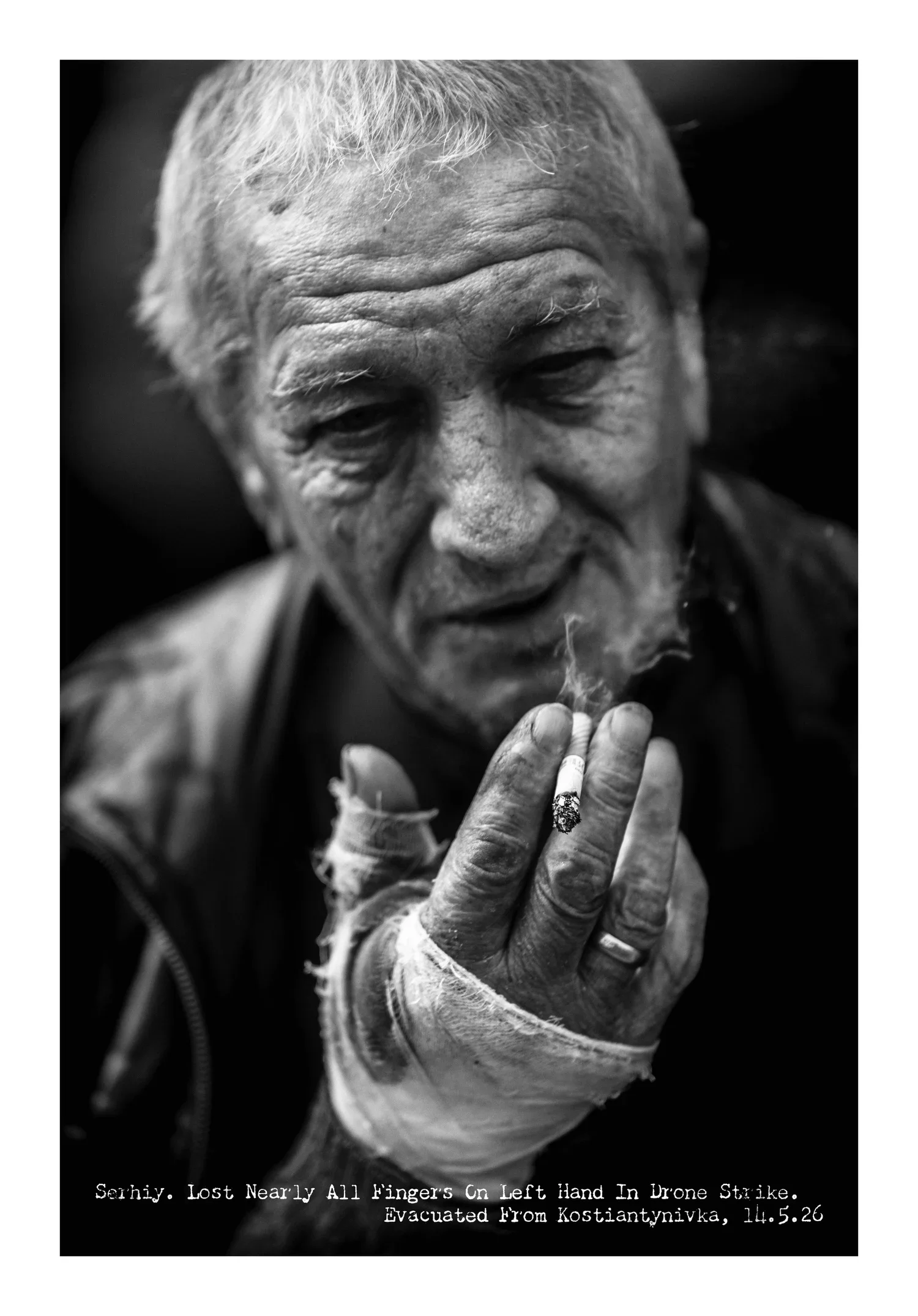
Serhiy. Lost Nearly All fingers On Left Hand In Drone Strike (Kharkiv Oblast, Ukraine), 2026. Archival silver gelatin print, handpulled silkscreen typescript, 61 × 91.4 cm (24 x 36 in.). Collection of the artist.
The Silent Migration
2026
May.
Ukraine.
Morning.
I am only one of countless many who have sat in this Ukrainian hotel bar waiting on a fixer with a sore back and a persistent sense of uncertainty, grasping at ghosts of motivations floating about the back of a scattered, underslept mind. The young waitress is live wire. Name: Mira. Back in Mexico, it means “to see.” Here: Peace. To come of age in a war zone while trembling with life in direct periphery to death--where peace is seen between death like clockwork. And the siren blares again. And no one flinches.
Midday.
The "boom" of mortars is a sensory shock that stays in your bones, especially when contrasted with the sterile, futuristic drone of a fleet of Iranian Shaheds. In a moment's time, one can witness the entire lifecycle of this conflict: the high-tech sensors of a robotic arm and the "dumb" iron of a mortar shell smacking the earth. The "mind-machine" disconnect of seeing amputees control robotic limbs with their thoughts while struggling to control your own racing mind is a jarring irony. The cognitive dissonance is the struggle to make a machine move, with that to make the mind quiet and still. It’s no wonder I feel "weird" and "sub-par"—I am watching humans be rebuilt while I feel like I'm being worn down by the scent of coal and diesel. The bar of usability for the work I am creating, I can see the "connective tissue" of war. However, I worry I have missed the heart of the story, as my own heart never drops below 110 beats per minute between and beneath the sky-scorching roar of missiles flying overhead, a sound more akin to God tearing open the heavens than to the inevitable hell that reigns down upon this land and its people.
Evening.
I can hear children playing outside even though it's late and half past dark. Everything sounds so normal that one might almost forget the war. I hope the air-raid sirens stay silent for now, as I'm certain the kids have been instructed to flee inside the second they sound. But for this brief moment of normalcy, of sanity, these kids will never know how much the echo of their laughter and the sound of shoes chasing one another across the pavement four stories below ease the city streets. As for the tension in my chest, the only thump I hear is a basketball, and the roar of a distant motorcyclist taking in the cool spring breeze. Everything sounds so damn normal on this beautiful evening in Dnipro City. So normal that I fear my own words, and I shall cut them short. To forget is to lose sight of the truth — a truth so distant from an entire waking world, far beyond the western horizon. As for the eastern front, chaos twiddles its thumbs, waiting for the moment, the very moment it believes the war has gone forgotten just long enough.
Night.
There are explosions all around my hotel, but I want to share a poem by Volodymyr Vakulenko before I go to the shelter, as in the shelter, I will be unable to see or hear.
Storks bring burned letters,
Stork post over the ash and ruins...
Wait for me, sun, wait in my dreams—
Whom will you meet at the dawn:
Primroses disheveled somewhere on treasures,
Or maybe a shattered, split stone?
Chechnya, Dagestan, Crimea, Karabakh,
And Kyiv in the bosom of its wounds.
A soul red hot with pain in the sky
Folds a burnt letter…
The storks fly. The day lay unbound
In the expanse of tears. Shots were fired.
The poem found beneath a Cherry Tree after his abduction and assassination.
Midnight.
It is now five days past the end of the ceasefire.
The war rages on, intensified.
I lay awake on the bathroom floor.
Goodnight.
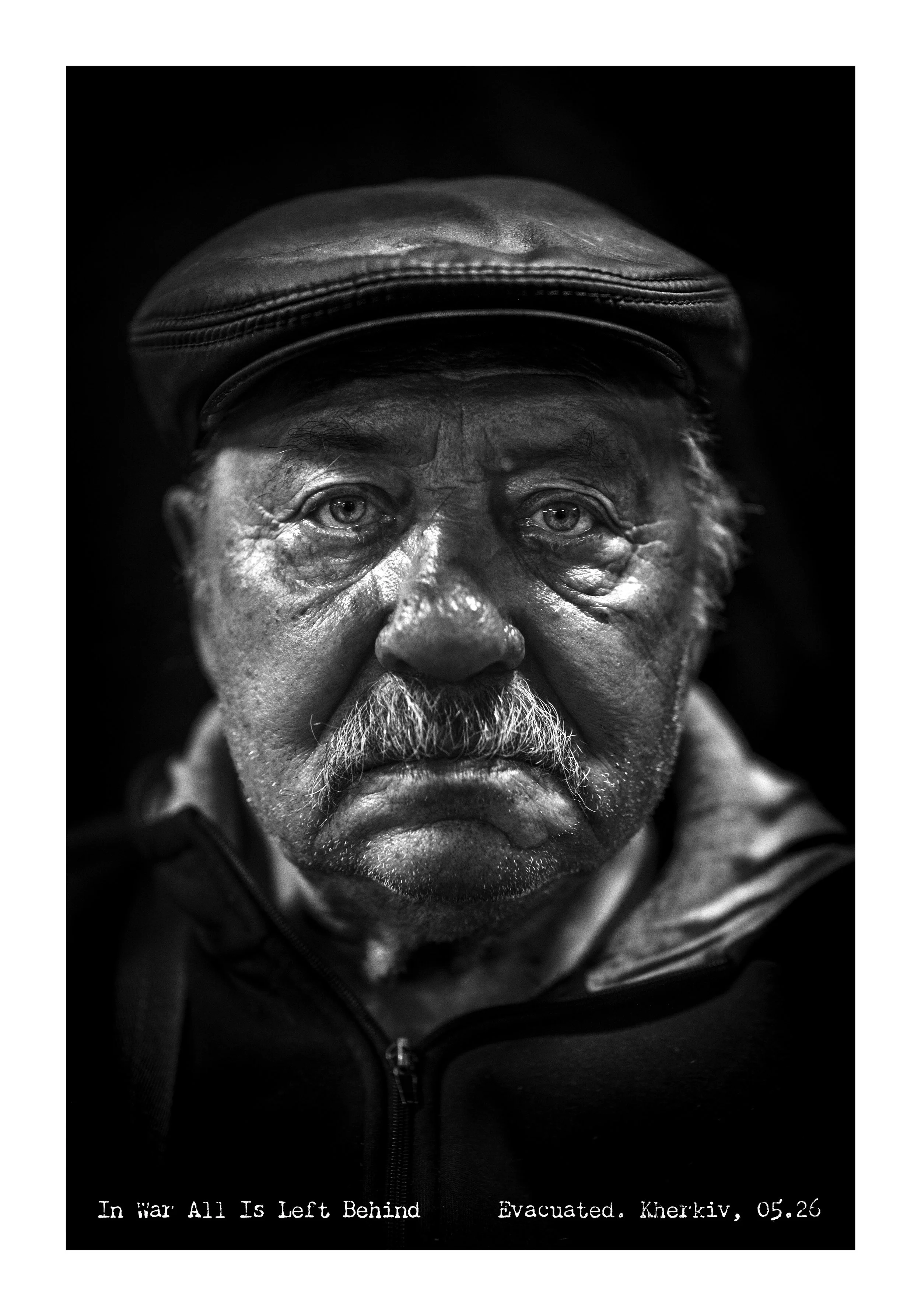
In War All Is Left Behind (Kharkiv Oblast, Ukraine), 2026. Archival silver gelatin print, handpulled silkscreen typescript, 61 × 91.4 cm (24 x 36 in.). Collection of the artist.
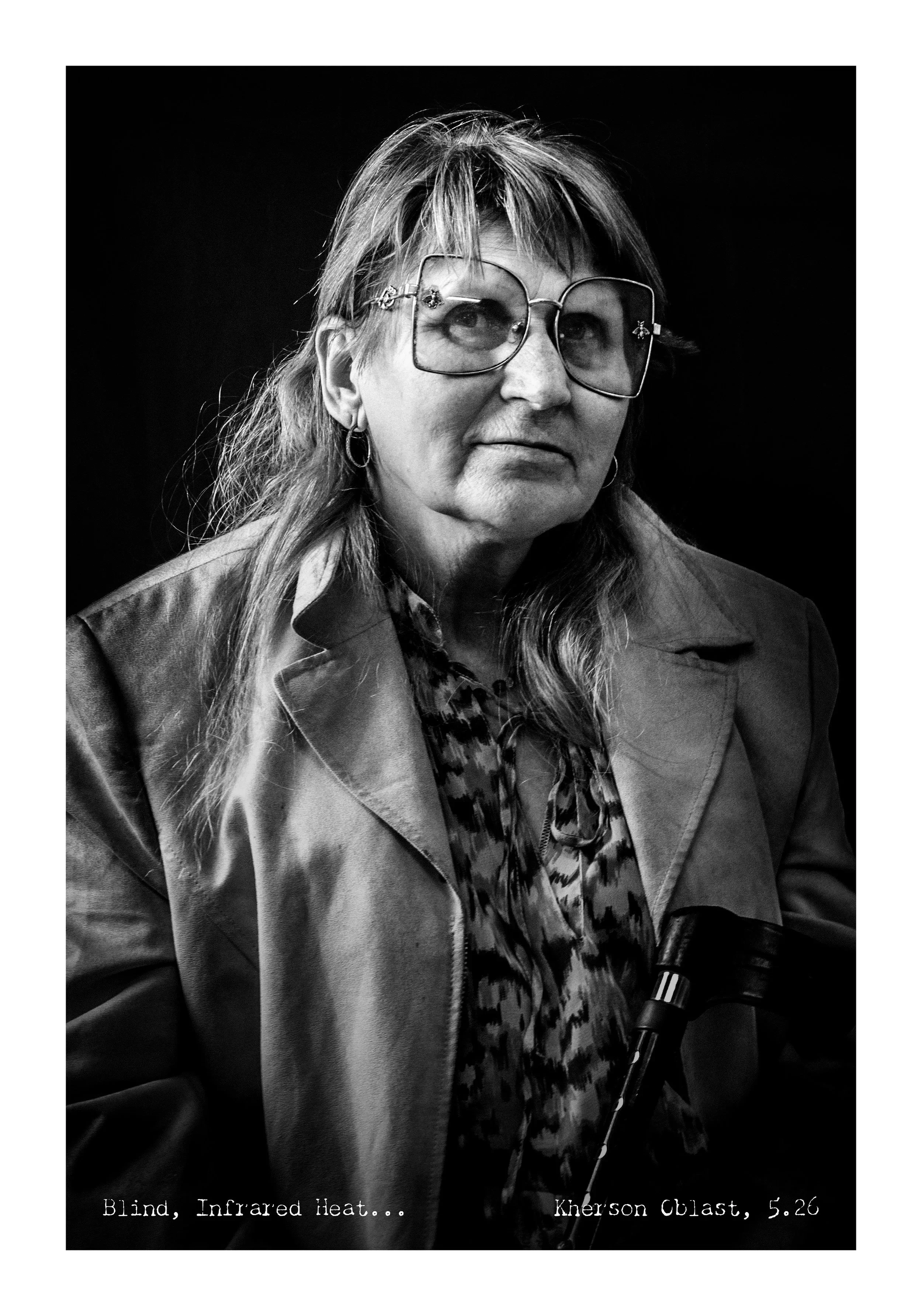
Blind, Infrared Heat… (Kherson Oblast, Ukraine), 2026. Archival silver gelatin print, handpulled silkscreen typescript, 61 × 91.4 cm (24 x 36 in.). Collection of the artist.
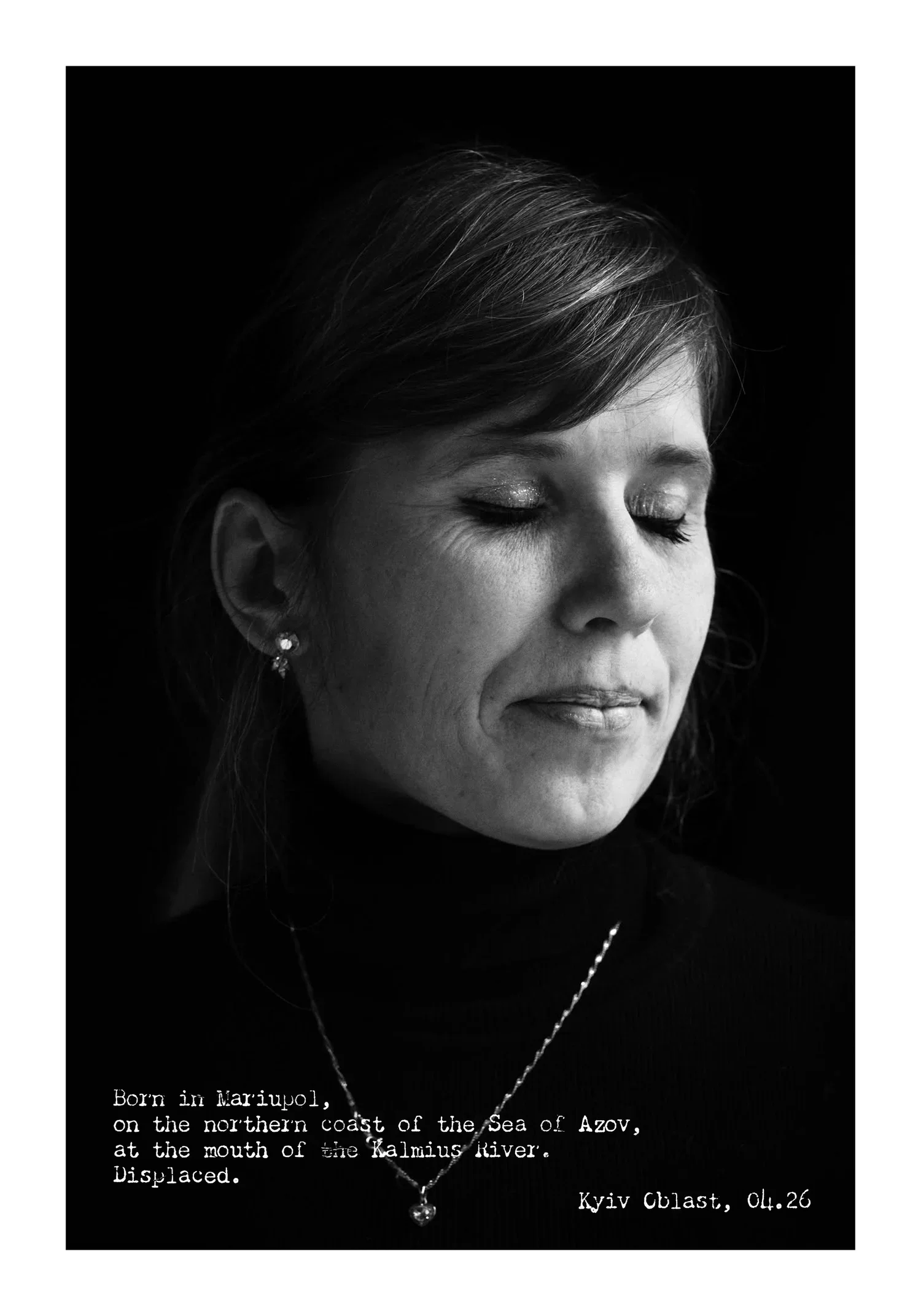
Born In Mariupol, On The Northern Coast Of The Sea Of Azov, At The Mouth Of The Kalmius River. Displaced (Kyiv Oblast, Ukraine), 2026. Archival silver gelatin print, handpulled silkscreen typescript, 61 × 91.4 cm (24 x 36 in.). Collection of the artist.
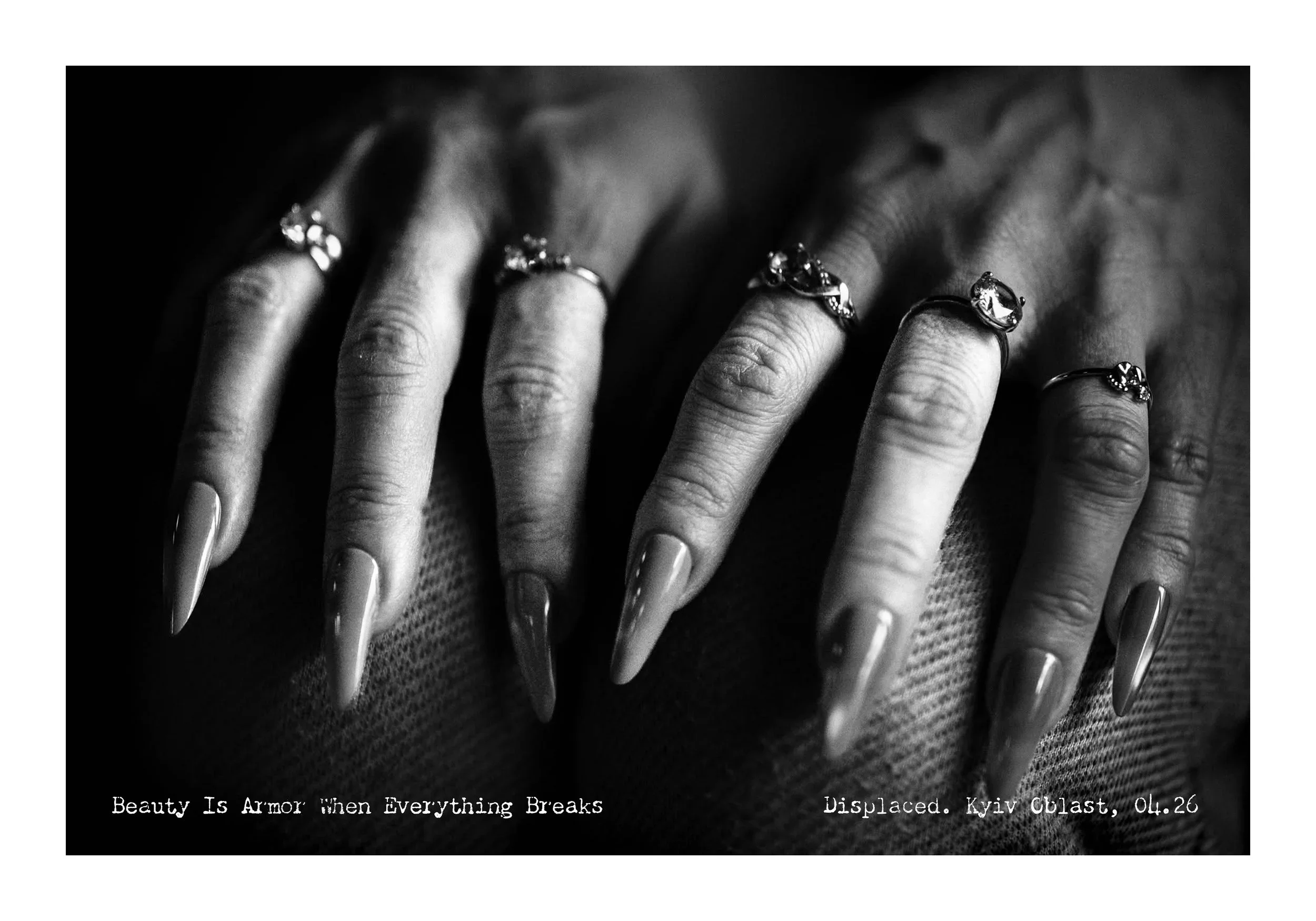
Beauty Is Armor When Everything Breaks (Kyiv Oblast, Ukraine), 2026. Archival silver gelatin print, handpulled silkscreen typescript, 61 × 91.4 cm (24 x 36 in.). Collection of the artist.
Tamara, Kherson Oblast
My name is Tamara. I was born in 1956 in the village of Tokaryvka, Kherson Oblast.
When our soldiers came, our village had already been under occupation for a year. That was two and a half years ago, and now there is no village left, just like all the buildings in the story. There is no place; it does not exist anymore. There were sisters, there were daughters, there were granddaughters, and so on. But as they say, it is good to be around, but I want to go home. Well, my soul hurts, but the heart is here now.
At the time, I was cooking for our soldiers — when they first came. I was cooking good food for them. But, as you can see, I was injured by a drone. Well, you know, it came, and my husband in the yard was killed. We had only one month left to celebrate our 50th wedding anniversary when he died. Now, it will be two and a half years since he was killed. The drone hit the garden. And then artillery came, and fragments completely blew up our home. We had been together there for 50 years.
I have one daughter; she is still in Kherson. She is 25 years old and works as a nurse in a hospital. My son-in-law is in Odessa. My granddaughter left for Lviv because her child, my great-granddaughter, is only 5 years old. There, too, she is a nurse. The child is in kindergarten and will soon be entering first grade. Her apartment in Lviv is very expensive, of course, 14 thousand. My great-granddaughter is smart. She goes to dance classes and gymnastics.
I am 56 years old. Retired now. I worked in a greenhouse and once in a store. That's it. But I remember everything about life. I graduated with a trade. But, you know, I used to come from the Vinnytsia region. My husband and I got married. We used to rent a house when we first arrived in 1977 in Tokaryvka. Then, you know, we did everything. And now I have become, as they say, a homeless person. No house. I used to have a big garden. Five acres. We had a farm. We had everything. As they say, we put everything into the house. We bought a car. Then we bought furniture for the house. My husband brought home all new furniture from the furniture factory. Because I wanted all the furniture to be white. That's it. Only white. And I did it. We furnished the whole house. We insulated it. We rebuilt the whole thing. And now there is nothing.
But I have started a little garden here out front. I dug it up there and planted it myself. I sowed everything there. I planted it. I bought tomatoes. There are flowers. That makes it somehow easier for me. But there often comes a time when you can't calm down. So, I relax with the earth. In the ground, somewhere, I can sit down. Where the earth might tell something to the soul. When I feel sorry for the house. When I feel sorry that I, myself, am left alive. That he was killed. That I have all these wounds, here, here, here... and here. I have a wound here, and here, and here. I don't have health. I don't have a job. There is so much pressure. The pressure will last until the end.
My daughter in Kherson calls every day. She will visit soon for the second time. It's scary. She lives, if you know, near the Kherson-Dnipro market. And she walks to the hospital for work because there are no trolleys. You see, there are so few buses that people are fighting for them. So, she walks. She says she must work around the clock. That's how it is. Her name is Tatiana. And we are all waiting for victory. And that's it. We hope that one day we will be in our yard, in our house. No matter how hard it will be, I want my own house. I want my own house. But there is nothing left. I feel so sorry for everything. You know, I feel so very sorry. Because I made it all myself. Just the two of us and our children.
(Tamara stood proudly over her budding garden out front the module housing she has been sheltering in for two and a half years, inside the red militarized zone of Kherson Oblast, the look of pride on her face as she reared life from the bare earth creating a deep sense of dissonance with the shaky words she had just spoken, born of the deep pain in her heart.)
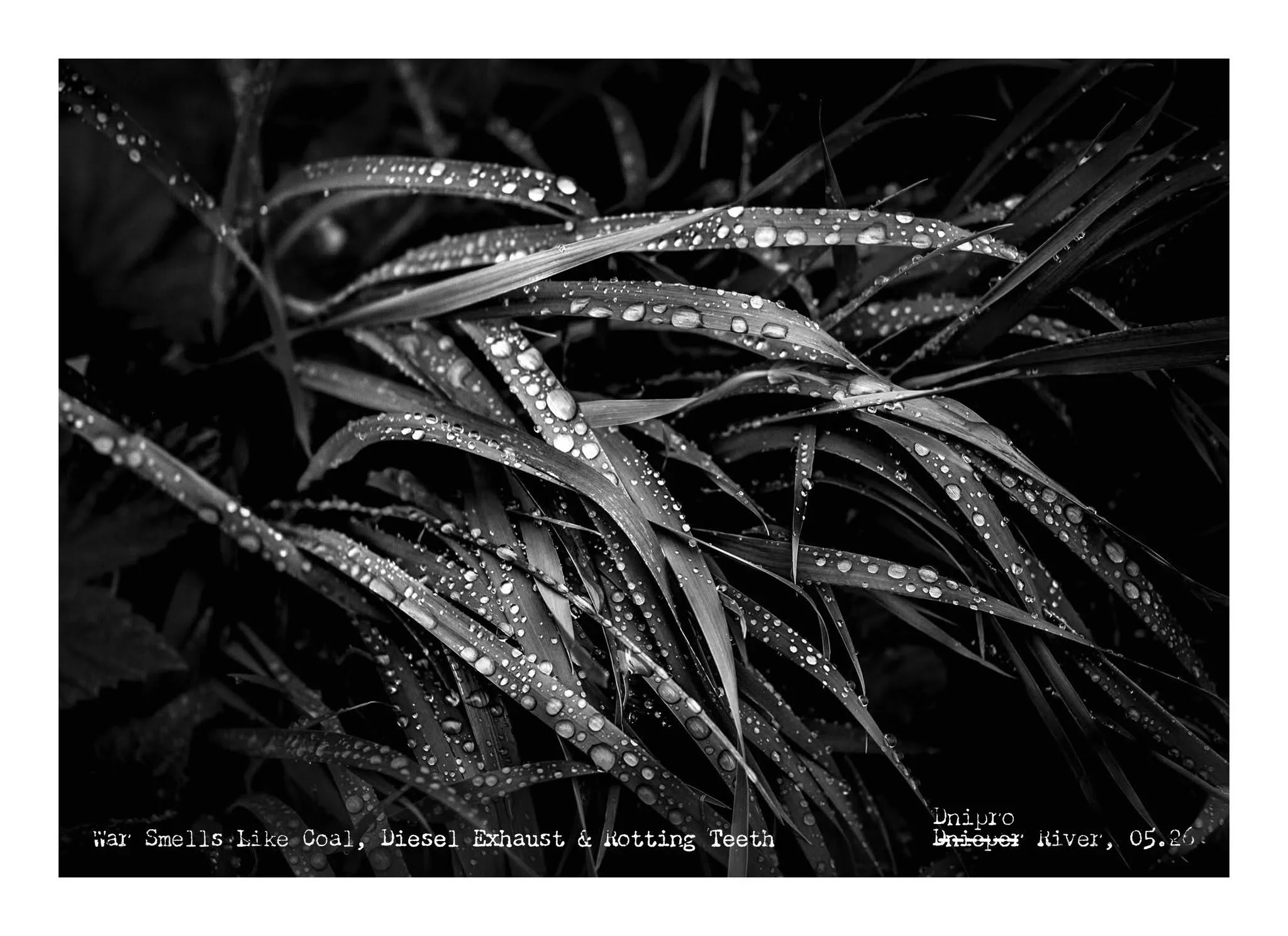
War Smells Like Coal, Diesel Exhaust & Rotting Teeth (Dnipro River, Ukraine), 2026. Archival silver gelatin print, handpulled silkscreen typescript, 61 × 91.4 cm (24 x 36 in.). Collection of the artist.
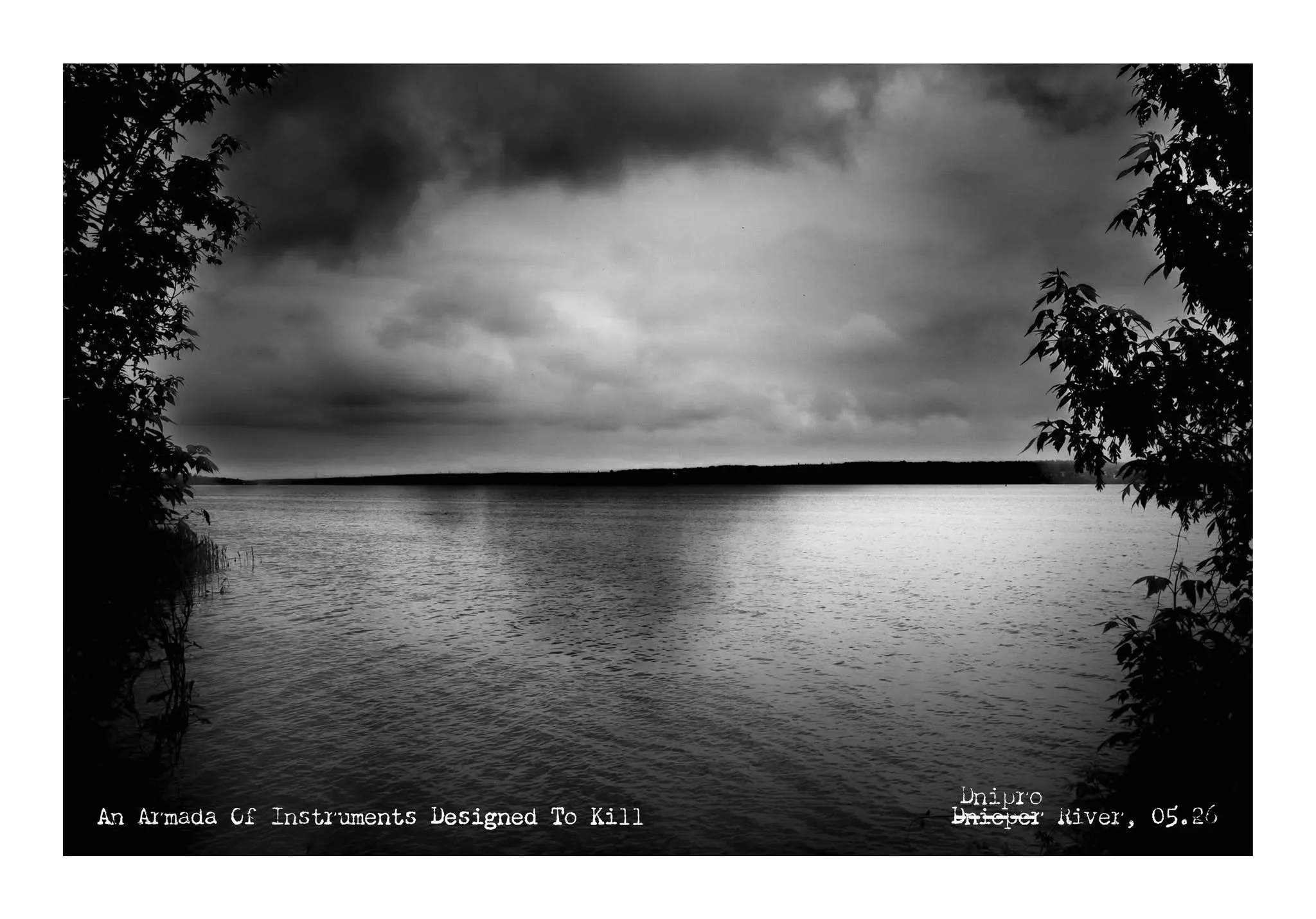
An Armada Of Instruments Designed To Kill (Dnipro River, Ukraine), 2026. Archival silver gelatin print, handpulled silkscreen typescript, 61 × 91.4 cm (24 x 36 in.). Collection of the artist.
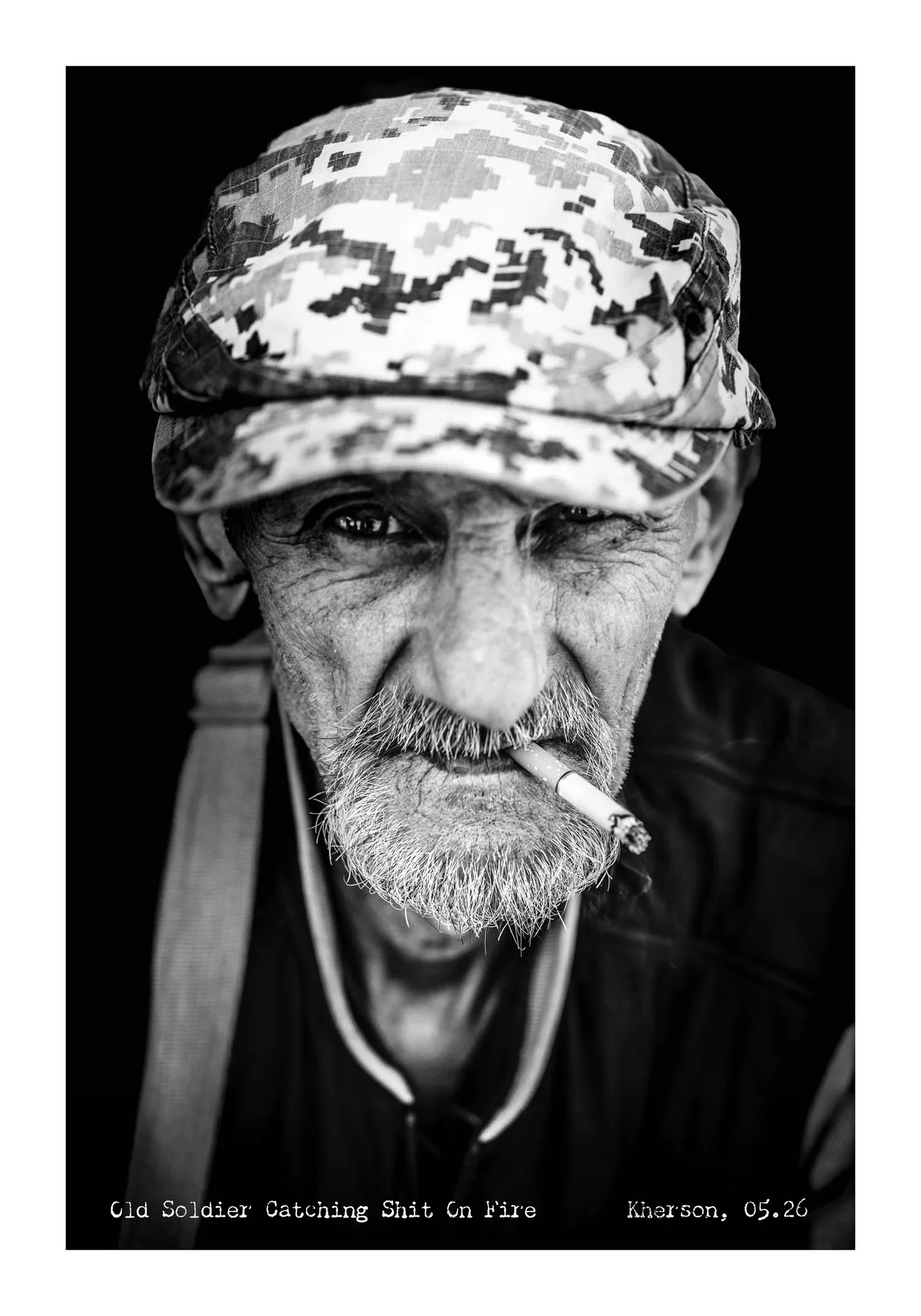
Old Soldier Catching Shit on Fire (Kherson, Ukraine), 2026. Archival silver gelatin print, handpulled silkscreen typescript, 61 × 91.4 cm (24 x 36 in.). Collection of the artist.
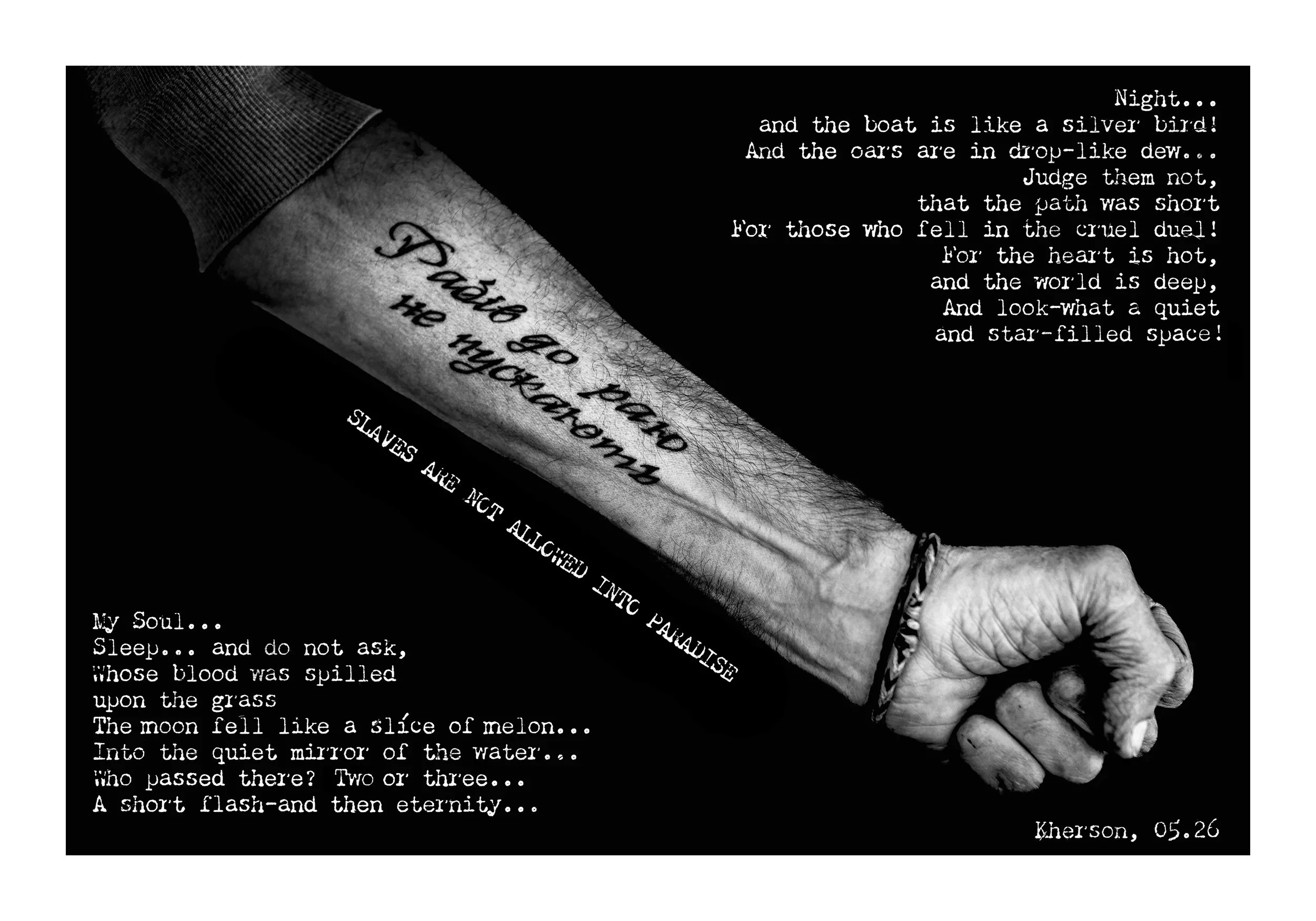
Slaves Are Not Allowed Into Paradise (Kherson, Ukraine), 2026. Archival silver gelatin print, handpulled silkscreen typescript, 61 × 91.4 cm (24 x 36 in.). Collection of the artist. Note: Text contains English translations of verses from the 1927 poem "Ніч... а човен – як срібний птах!.." and the 1926 poem "Судіть їх не, що шлях був короткий..." by Ukrainian poet Yevhen Pluzhnyk (1898–1936).
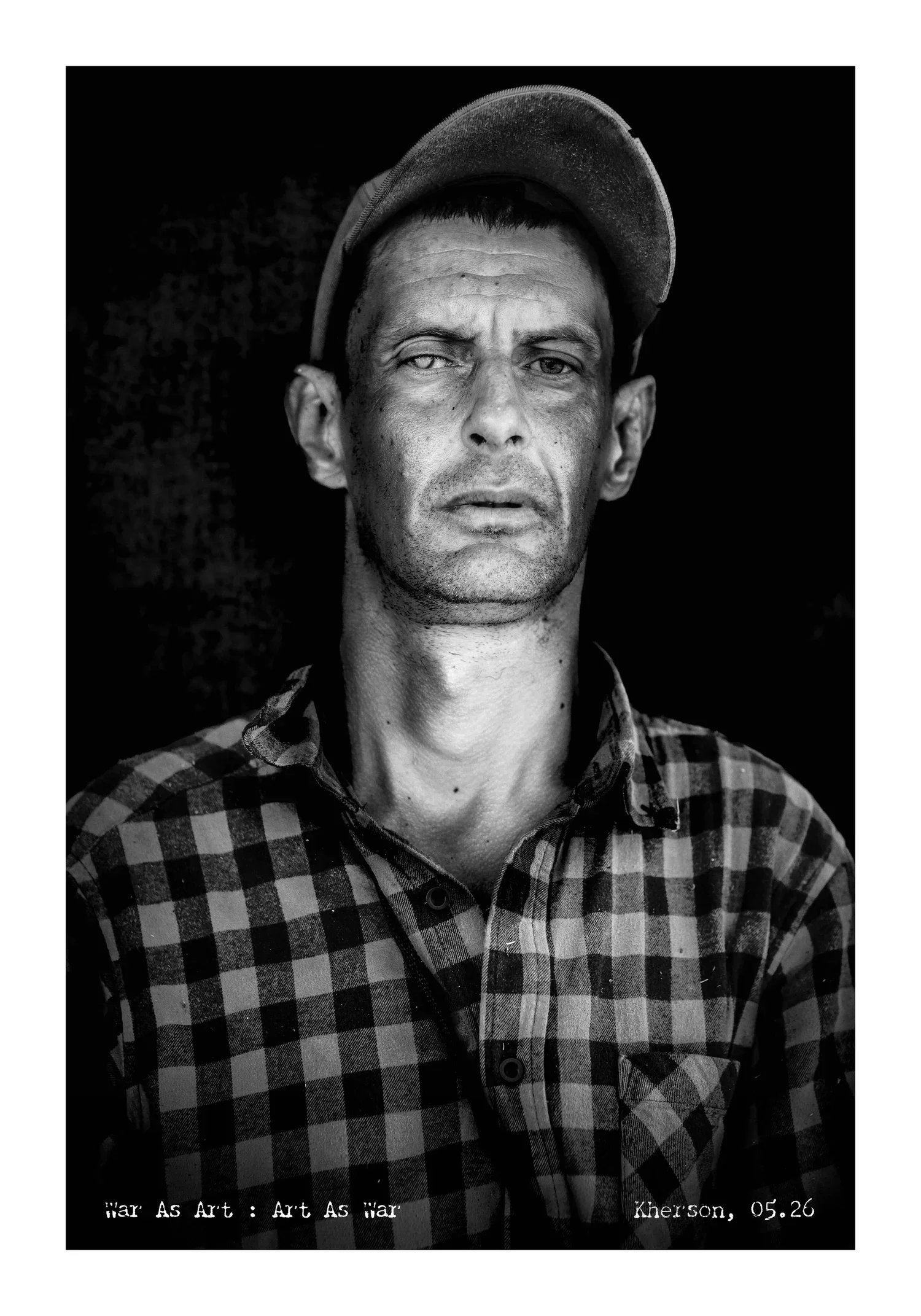
War As Art : Art As War (Kherson, Ukraine), 2026. Archival silver gelatin print, handpulled silkscreen typescript, 61 × 91.4 cm (24 x 36 in.). Collection of the artist.
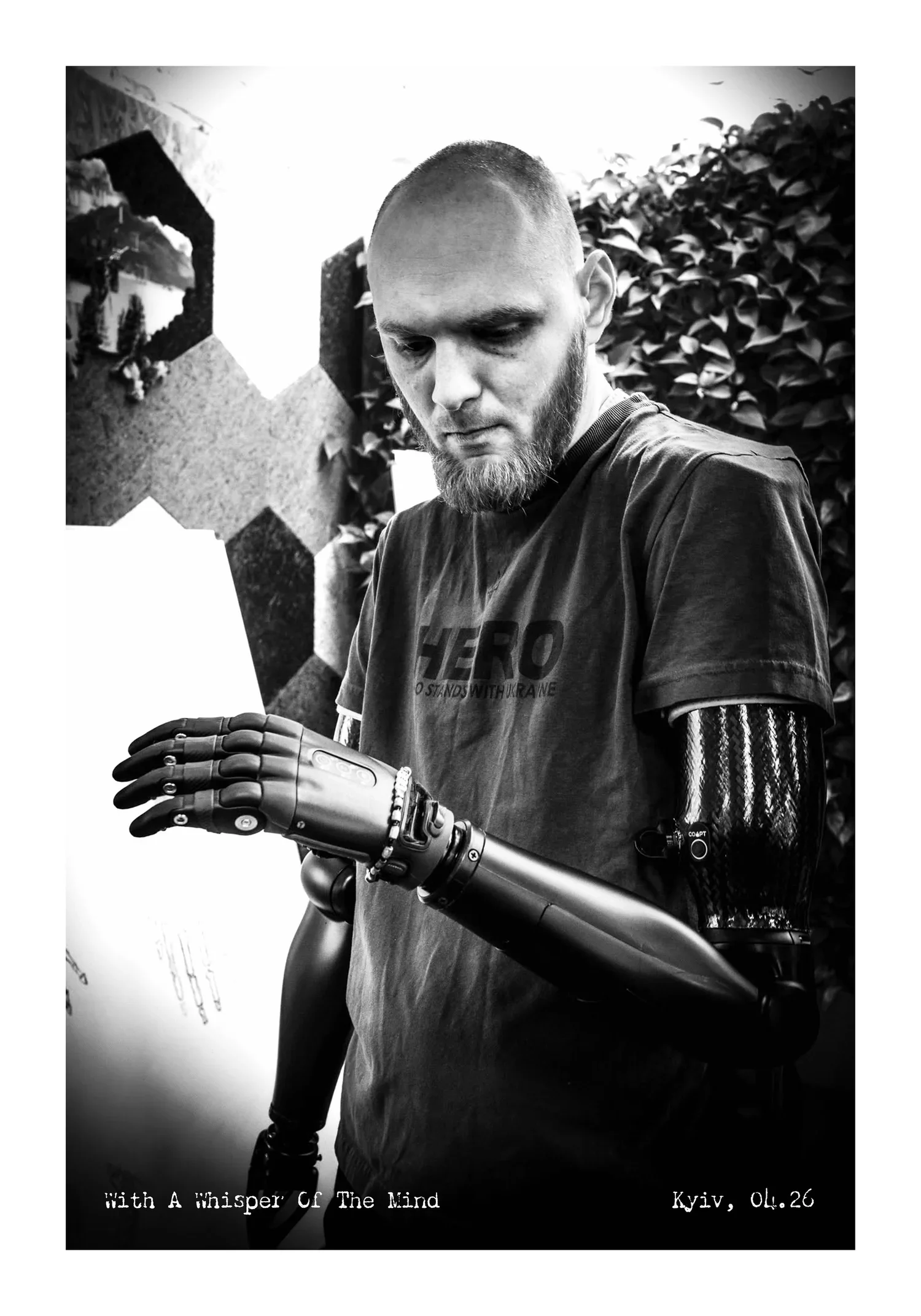
With A Whisper Of The Mind (Kyiv, Ukraine), 2026. Archival silver gelatin print, handpulled silkscreen typescript, 61 × 91.4 cm (24 x 36 in.). Collection of the artist.
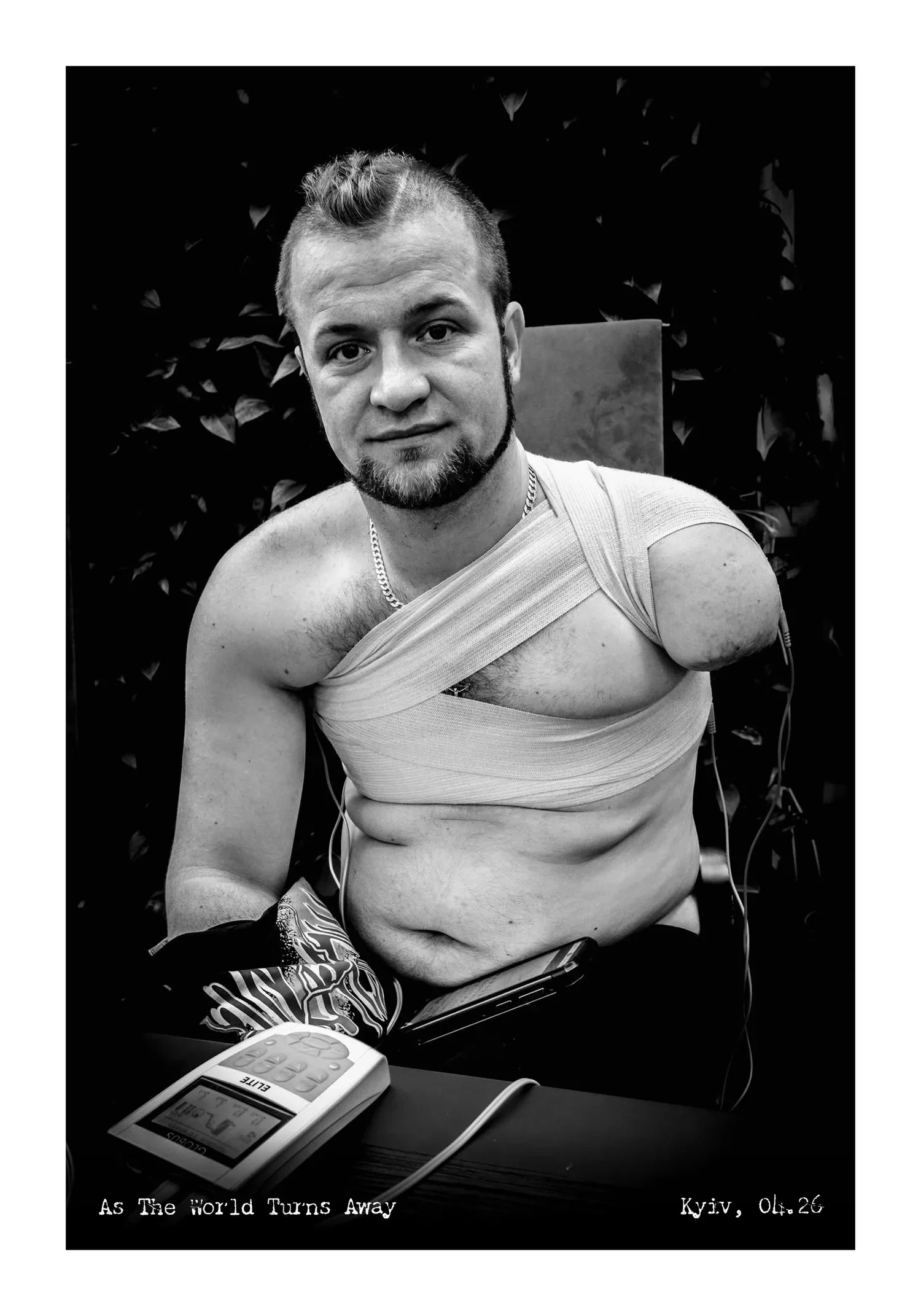
As The World Turns Away (Kyiv, Ukraine), 2026. Archival silver gelatin print, handpulled silkscreen typescript, 61 x 91.4 cm (24 x 36 in.). Collection of the artist.
Lyudmyla, Odesa Oblast
You know, it used to be calmer. It can be quiet for a week, and then the windows are shaking, the doors are shaking, and we are shaking when the bombing is close.
My name is Lyudmyla. I am 68 years old. I am from Kiselevka; my mother brought me there 22 years ago. She is 90 years old now, born in 1935. Since the war began, my mother has gone completely blind. She walks badly; well, she practically does not walk at all. I still want her to walk and move, so I slowly take her to the places we need to go. But basically, she mostly lies and sits, and that's it. We left Kiselevka together. It was impossible to live there in the village; we were already being heavily bombed.
We did not leave at first. Not until we had to be rescued when Kiselevka was first under occupation. And thank God, the Russians did not kill us before our soldiers came and freed us just in time. We left on March 28, right as the Russians arrived. Our rescuers took everyone away in cars, and all the diesel fuel that had been there before the Russians completely destroyed our village. All the houses burned. My house, too, and probably no houses have survived completely.
Even before we left, our roof was broken. It was raining and snowing, and everything was leaking. The ceilings were falling, and everything was rotten. Everything was broken. Everything. Everything was ruined. And now, there is nothing left. As my mother says, “There is not even a leg left.” The conditions here at the shelter are wonderful for us. We each have our own rooms. We have everything, thank God. A shower and a toilet in our room. Everything is convenient for us. It's warm for my mother. She is my family; it’s just me and my mother.
During our time here, all of us strangers have become related. We all worry about each other, help each other, support each other, and check in on someone if they haven’t left their room in a while. There are now 100 of us here. But at first there were 300 or more. Every space was filled. Before, two families lived in a single room, even four in some; there were so many of us, and there was not enough space. God grant her health and the whole family of the woman who has sheltered us here. She completely freed us.
When I arrived on August 3rd with my mother, I began feeding the animals. We feed the cats and dogs, and we sterilized all the cats when volunteers came to help us. Sometimes they come to bring food for the dogs. We don't let anyone starve.The animals calm me down very much. I have two cats in my room. I took one for the winter, and then another cat was born. It's good to have two; Musya and Buysa. I worry a lot. I worry about my health. I'm constantly on blood pressure pills. I worry about sugar, age, and nerves. I don't know. My hip hurts, and my knee hurts. My joints hurt. My hip, my back. And my mother, she is constantly on medicine. The day begins and ends with pills.
Thank God it's quiet for a moment, but the bombing can be very loud. It used to be quieter. But Odessa is being bombed hard now, and we hear it all from the South. But God willing, I’m doing fine, not worse. We take our pills, talk to each other, and distract one another back and forth. We have our lunch, then our dinner, and we stand around and talk. But I have decided that when it's all over, I want to go home. I want peace. Most importantly, I want peace and that they don't bomb us anymore.
(Moments later, the concussive blasts from nearby mortar shelling can be heard once again. There are no shelters to flee to. Only a fifteen-story complex, rising vulnerably high above the sandy earth. Once a vacation resort, the building now houses 100 internally displaced people and sits a kilometer from the Black Sea coastline, with beach access closed off with barbed wire and iron hedgehogs, strategically placed to slow the advance of Russian tanks.)
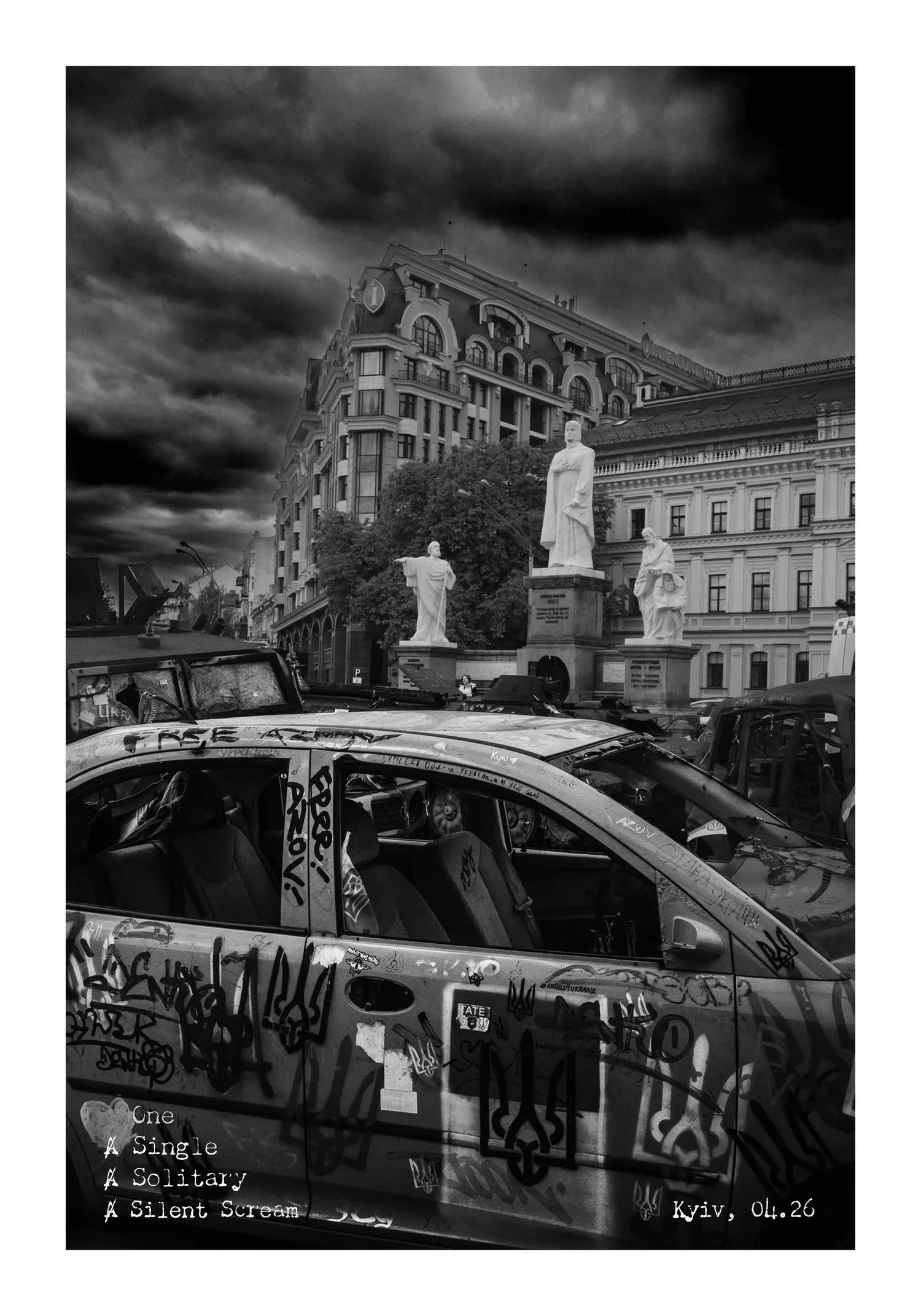
A Silent Scream (Kyiv, Ukraine), 2026. Archival silver gelatin print, handpulled silkscreen typescript, 61 × 91.4 cm (24 x 36 in.). Collection of the artist.
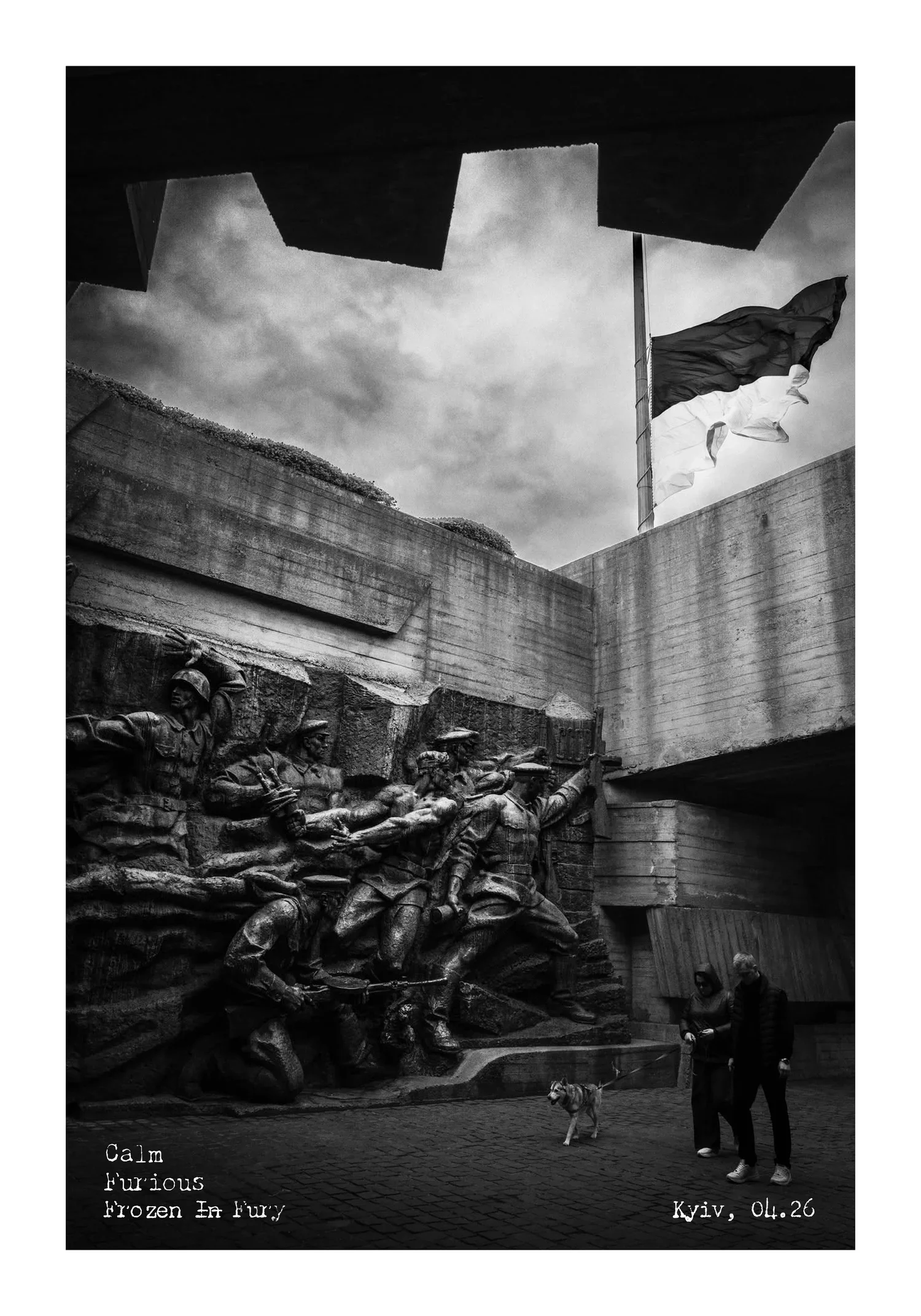
Frozen In Fury (Kyiv, Ukraine), 2026. Archival silver gelatin print, handpulled silkscreen typescript, 61 × 91.4 cm (24 x 36 in.). Collection of the artist.
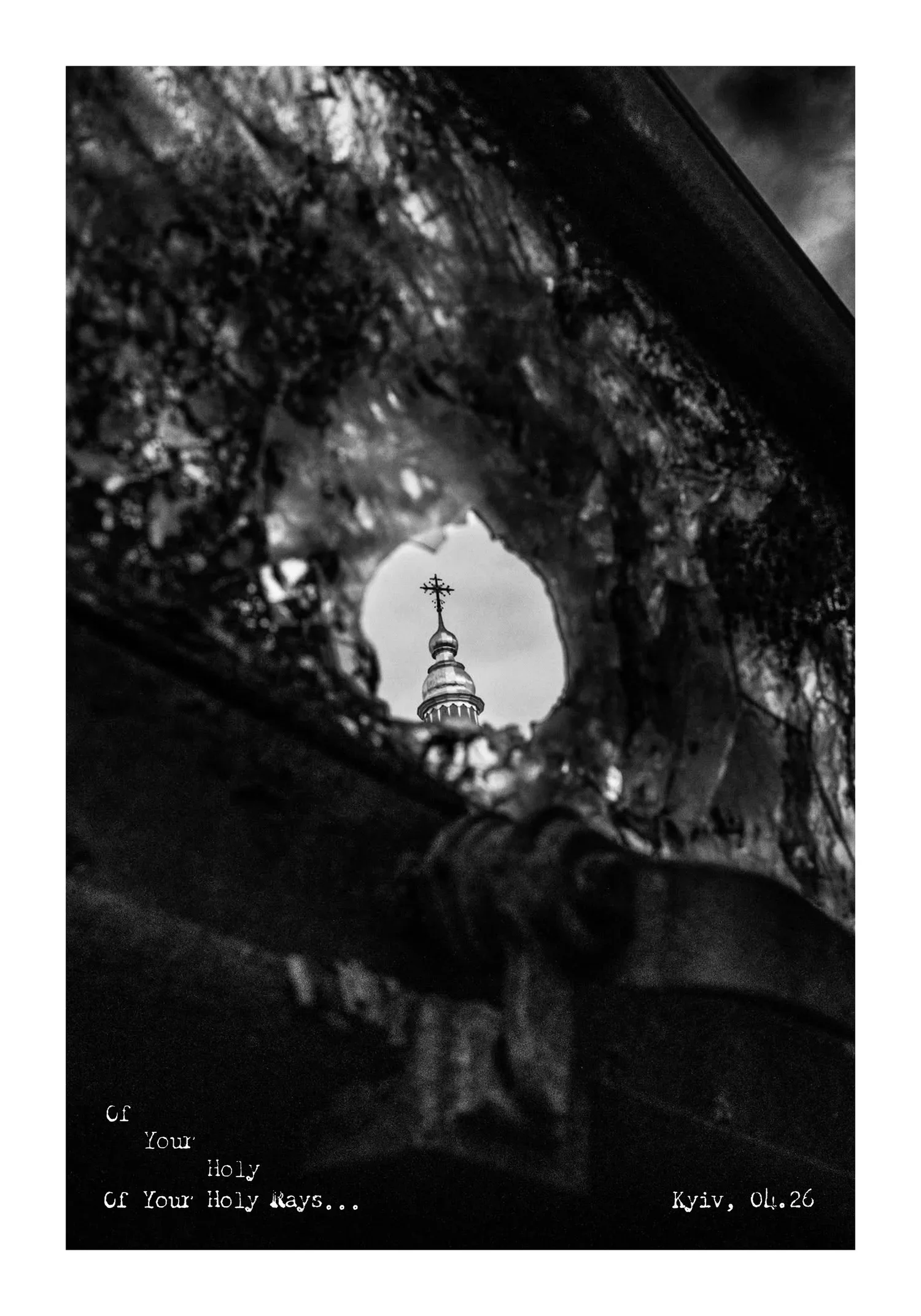
Of Your Holy Rays (Kyiv, Ukraine), 2026. Archival silver gelatin print, handpulled silkscreen typescript, 61 × 91.4 cm (24 x 36 in.). Collection of the artist.
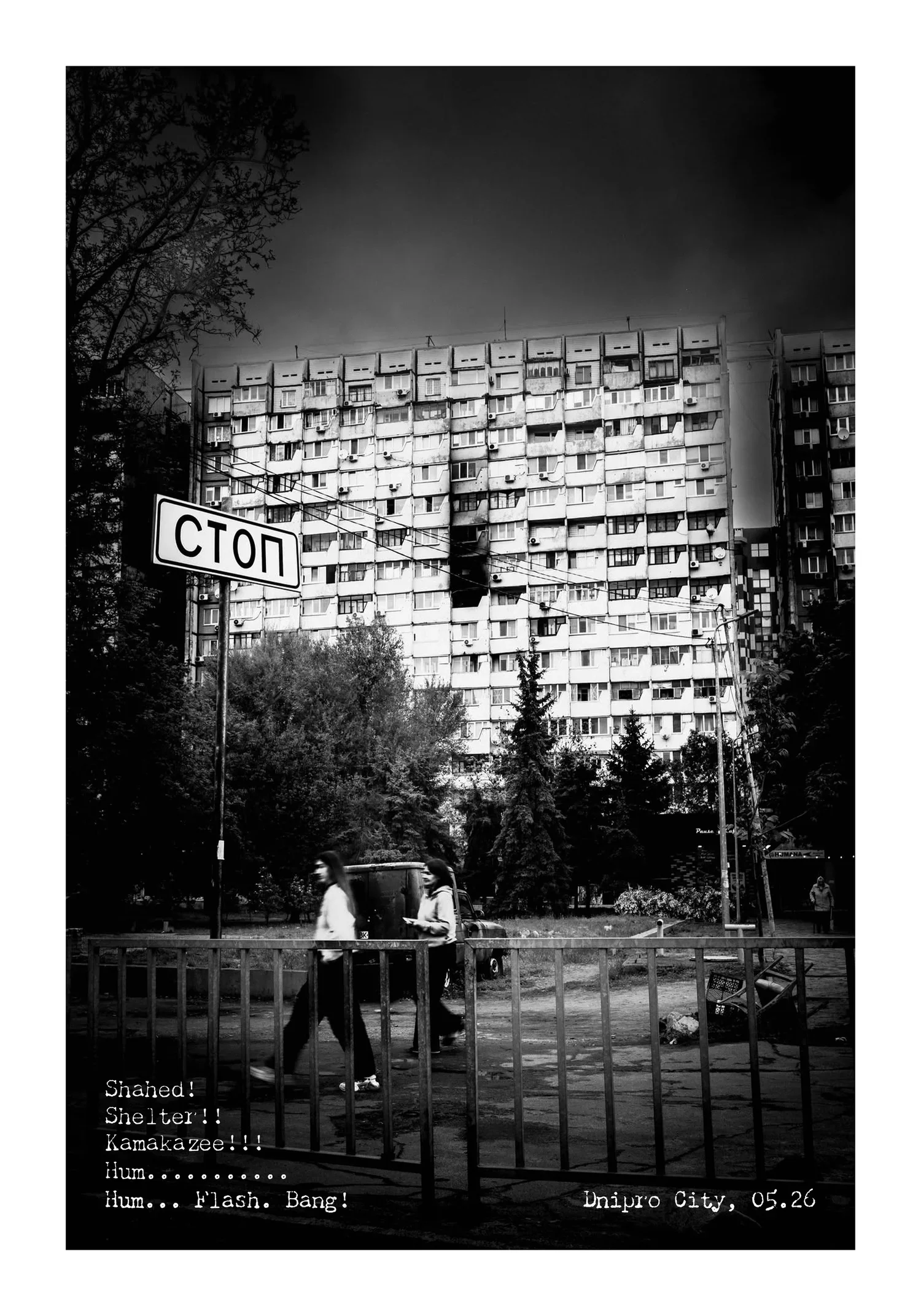
Hum... Flash. Bang! (Dnipro City, Ukraine), 2026. Archival silver gelatin print, handpulled silkscreen typescript, 61 × 91.4 cm (24 x 36 in.). Collection of the artist.
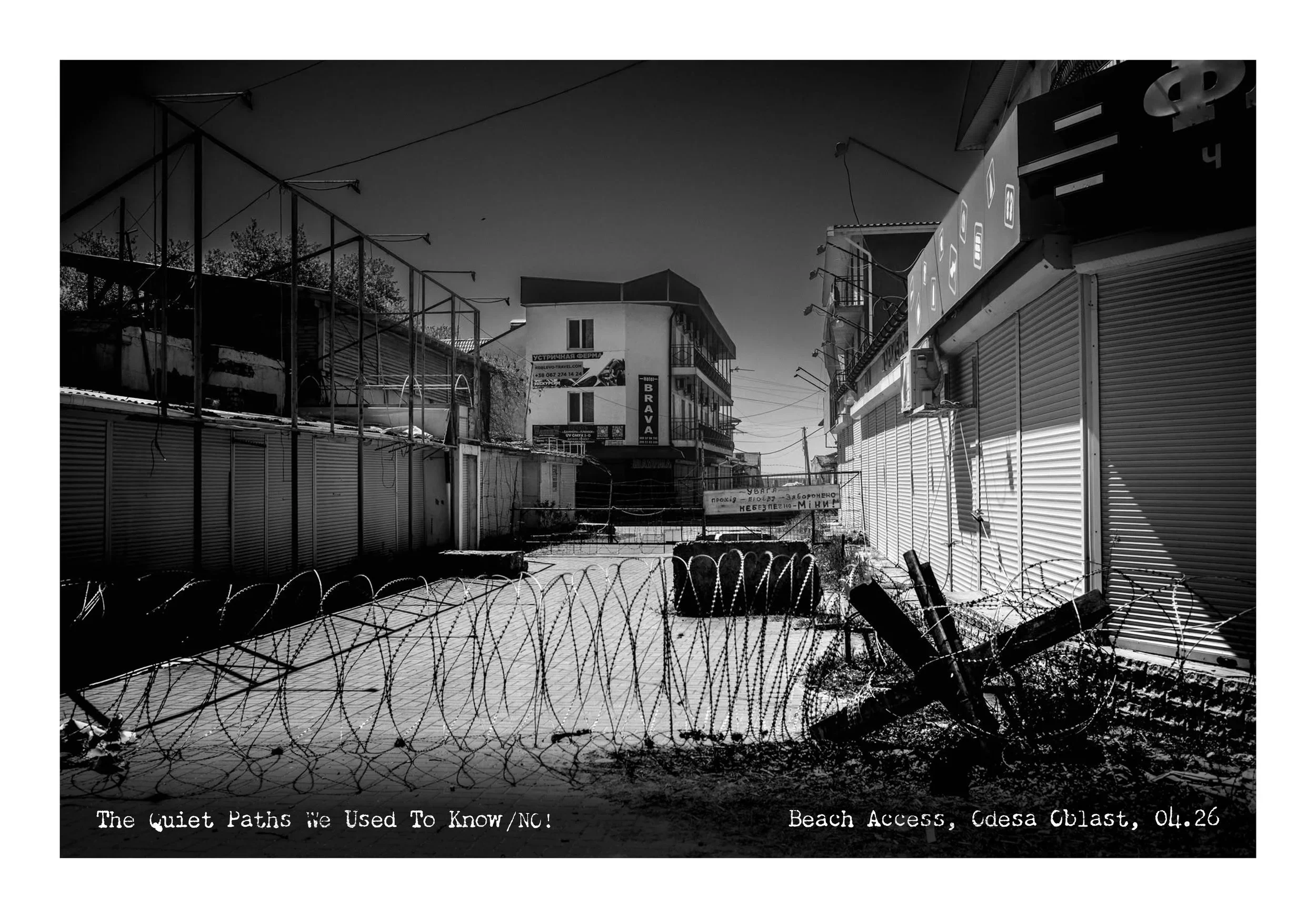
The Quiet Paths We Used To Know (Beach Access, Odesa Oblast, Ukraine), 2026. Archival silver gelatin print, hand-pulled silkscreen typescript, 61 x 91.4 cm (24 x 36 in.). Collection of the artist
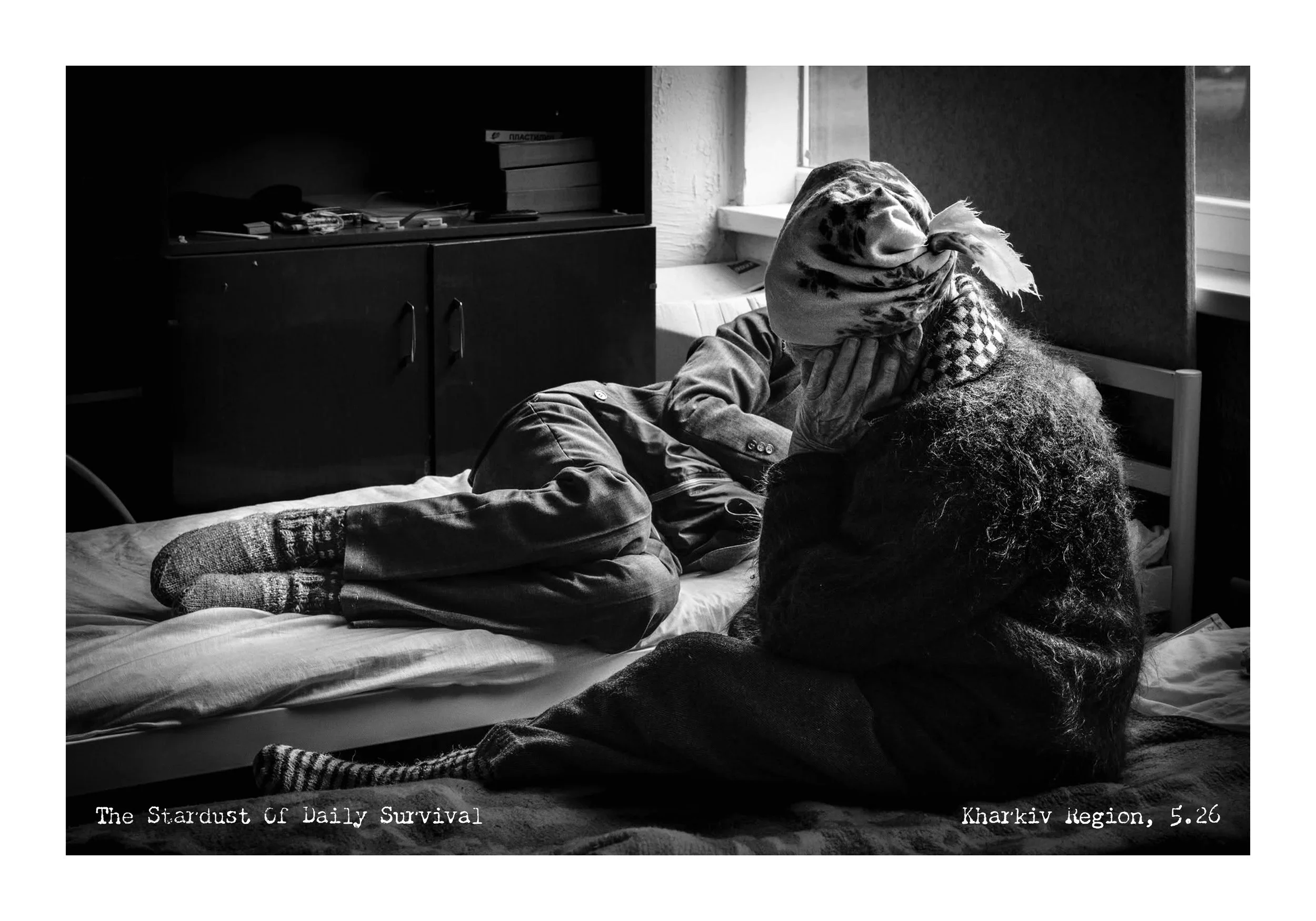
The Stardust Of Daily Survival (Kharkiv Oblast, Ukraine), 2026. Archival silver gelatin print, handpulled silkscreen typescript, 61 × 91.4 cm (24 x 36 in.). Collection of the artist.
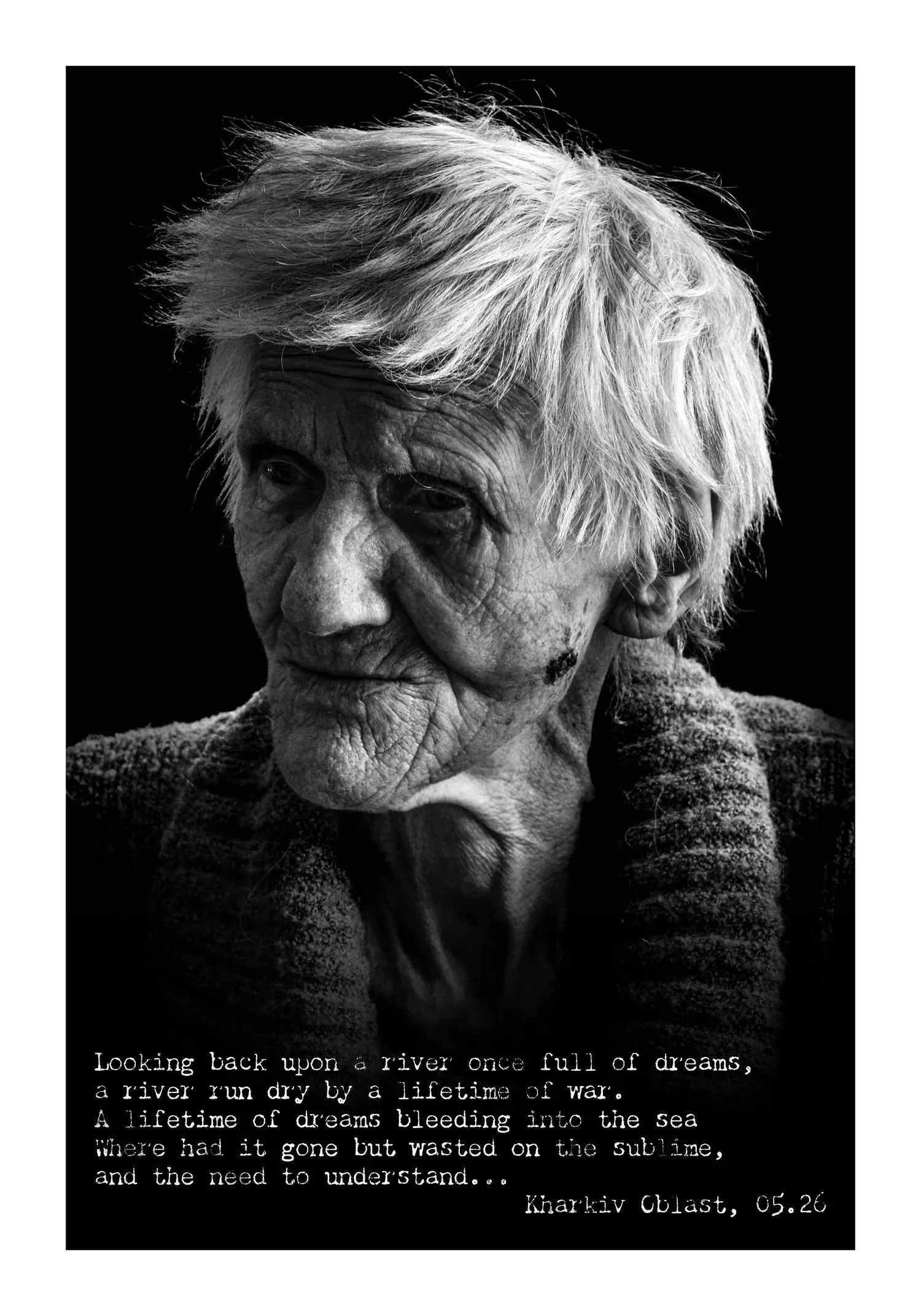
Looking Back Upon A River Once Full Of Dreams, A River Run Dry By A Lifetime Of War. A Lifetime Of Dreams Bleeding Into The Sea. Where Had It Gone But Wasted On The Sublime, And The Need To Understand... (Kharkiv Oblast, Ukraine), 2026. Archival silver gelatin print, handpulled silkscreen typescript, 61 × 91.4 cm (24 x 36 in.). Collection of the artist.
Elvira, Kharkiv Oblast
My name is Elvira. I am 60. I am from Donbas.
It's a disease. It's a disease of the brain. I am a disabled person.
I was in Donetsk. I have this inscription… Let me tell you.
In 2000. No, in 2019. In 1919. What am I saying... I am sorry. I got confused. I am sorry.
In 2014, our Ukrainian military sent me here for treatment. I lived in Kherson. No, in the village of Veletensky. There was a laboratory in the village of Veletensky. A neurology hospital. They put me in neurology. And I worked in the dormitory. And I felt very good.
In the village, there was a boy. There was a boy. I lived there. And now I am here. We came by foot. We came to a town, then took a train, and then came here.
At first, I had a blockage of one eye, then I had an atrophy of the face; in short, it was bad. And now this atrophy has grown to the point that I cannot walk. But I can… I can walk.
This is the only way I know how to explain it.
Here, the distance has grown.
This should be guidance to you all.
(Elvira appears to be 20+ years older than she claims. She suffers from dementia and is housed in an old school building repurposed into a hospital and evacuation hub for displaced persons from the frontline. The room she is in is designated for the elderly who can no longer care for themselves. The smell in the room is atrocious and beyond what words can describe. But it is one I have become familiar with, as it lingers throughout the country, mostly in repurposed centers like these, mobile humanitarian clinics operating out of schools, subways, and restaurants and bars of urban train stations, which have been forced to cease operations over the course of the war. Elvira struggles to grasp onto the here and now as the there and then invade her mind, sat propped up on the edge of her hospital bed as her blood pressure is checked by the quiet and patient nurse kneeling down at her side. The weight of witnessing such suffering is overbearing, and soon I forget all about the scent of human rot, even as it permeates my sinus cavities, where it shall remain for the remainder of time.)
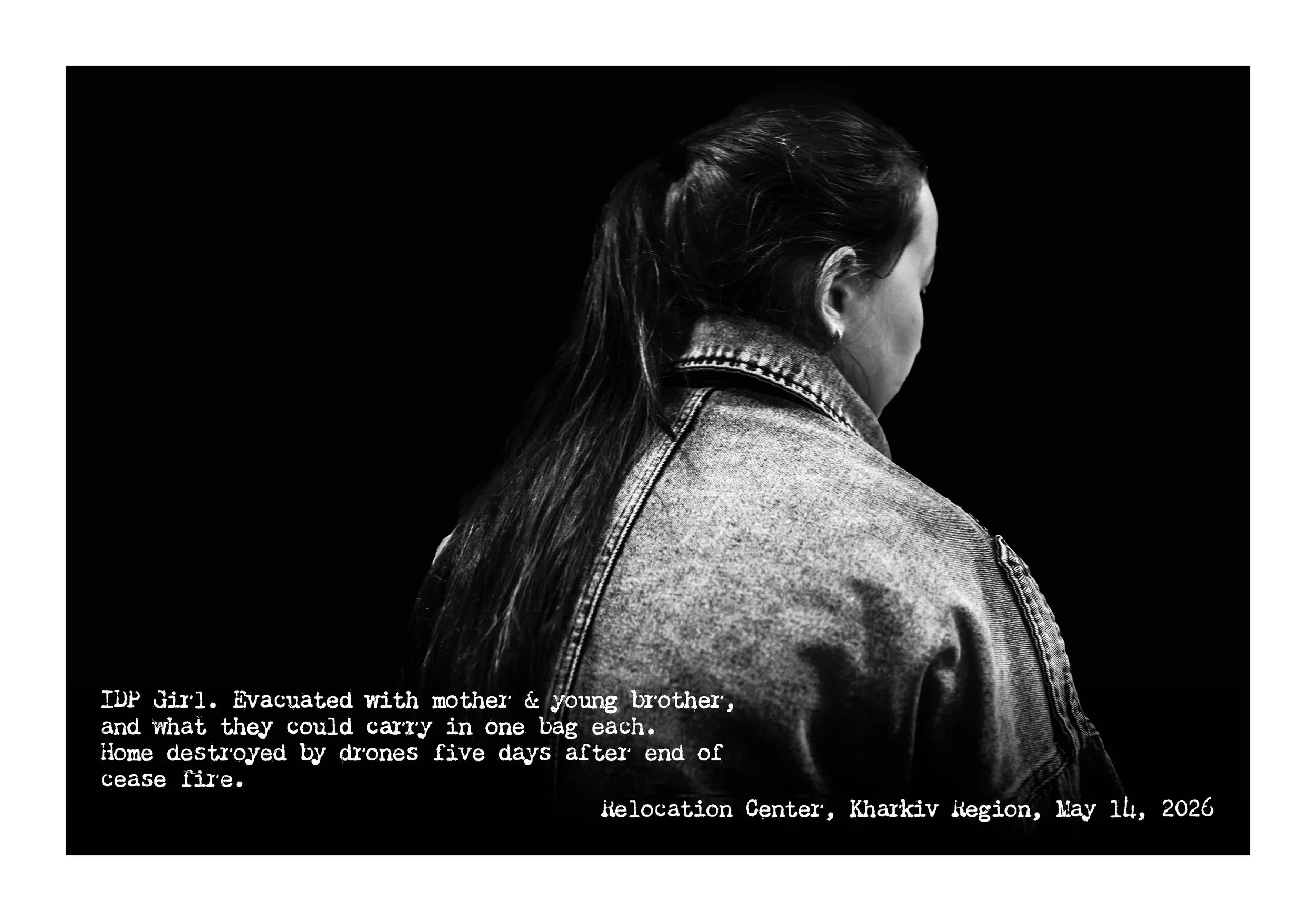
IDP Girl. Evacuated With Mother & Young Brother, And What They Could Carry In One Bag Each. Home destroyed Five Days After End Of Cease Fire (Relocation center, Kharkiv Oblast, Ukraine), 2026. Archival silver gelatin print, handpulled silkscreen typescript, 61 × 91.4 cm (24 x 36 in.). Collection of the artist.
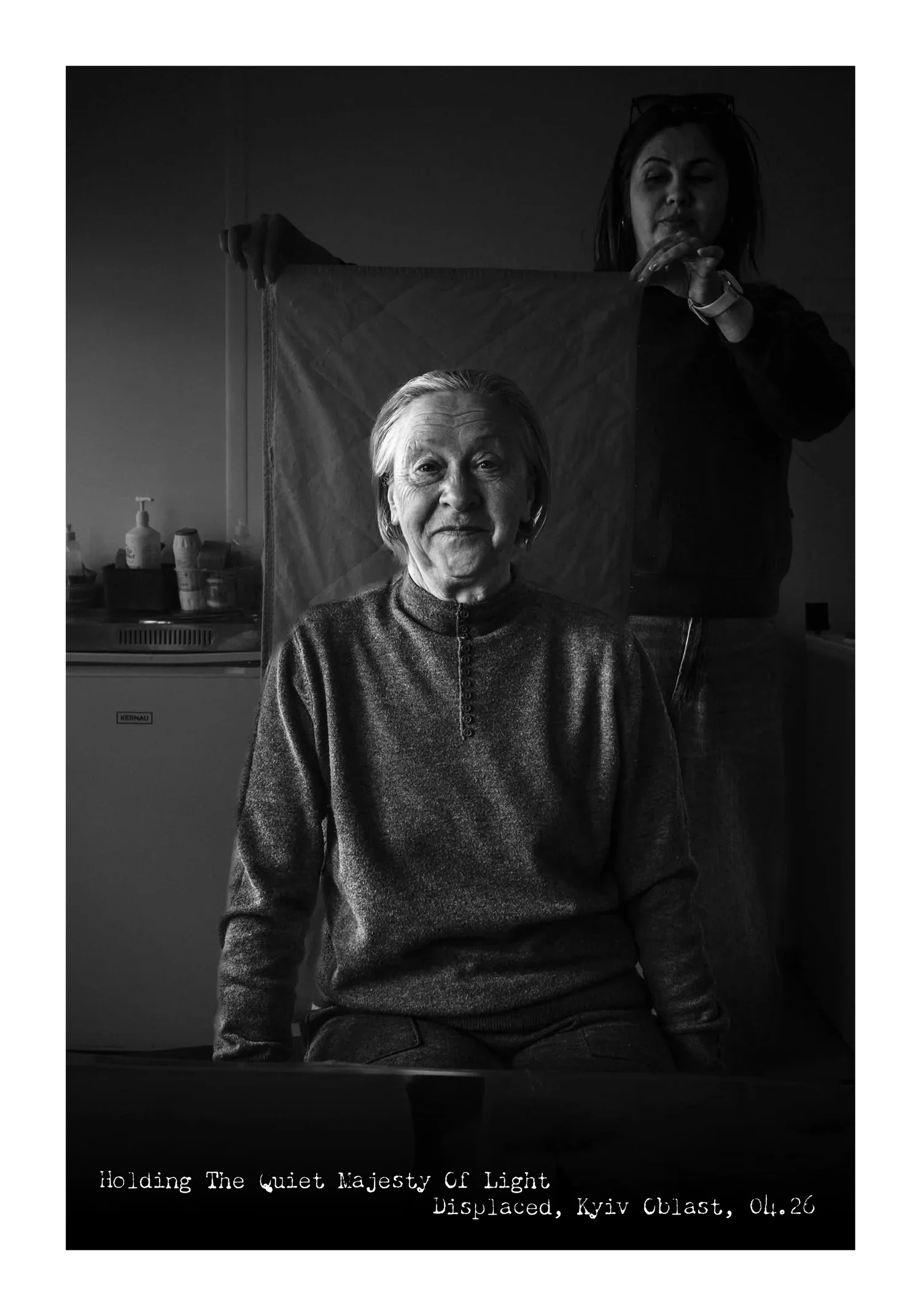
Holding The Quiet Majesty Of Light (Displaced, Kyiv Oblast, Ukraine), 2026. Archival silver gelatin print, handpulled silkscreen typescript, 61 × 91.4 cm (24 x 36 in.). Collection of the artist.
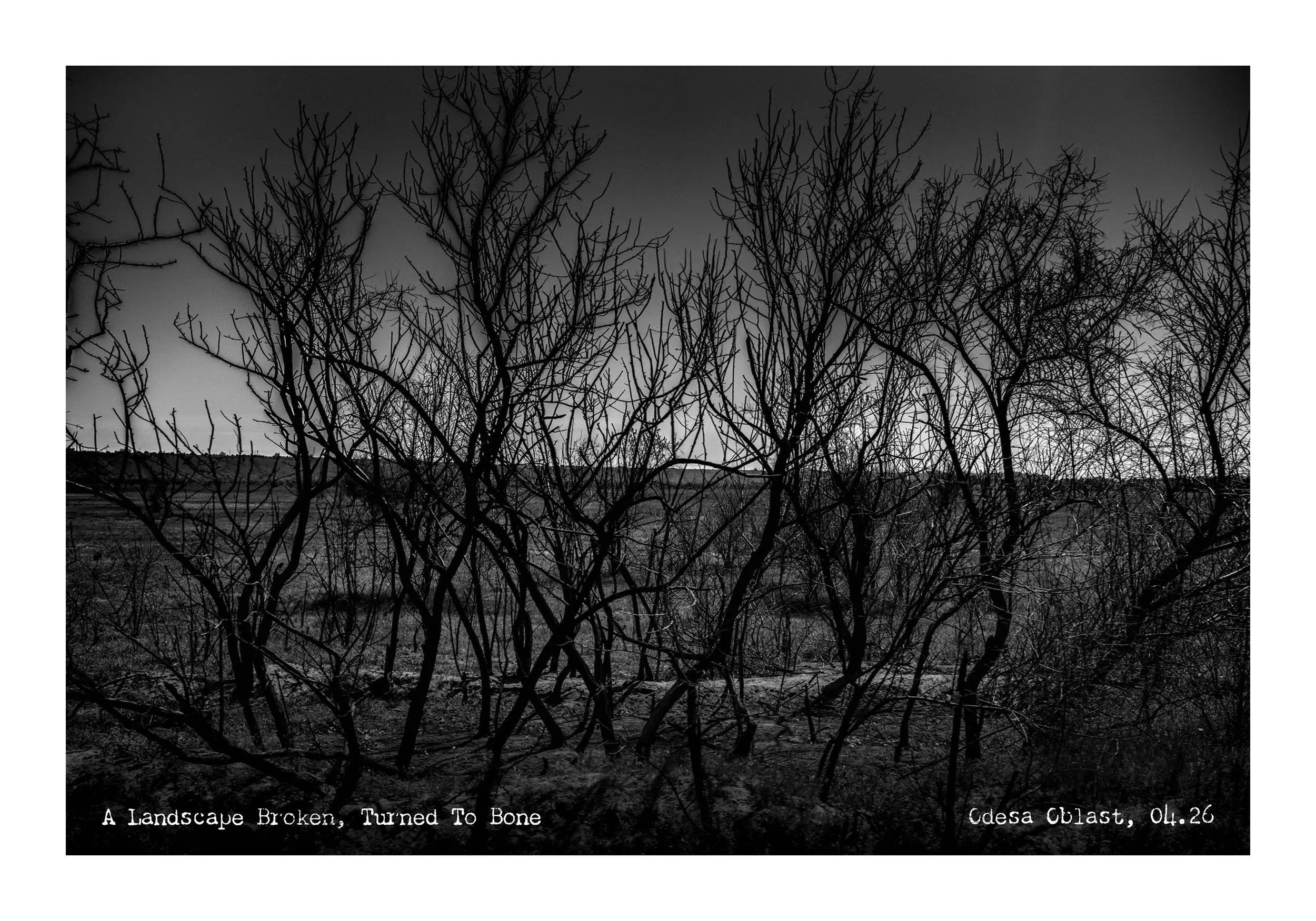
A Landscape Broken, Turned To Bone (Odesa Oblast, Ukraine), 2026. Archival silver gelatin print, handpulled silkscreen typescript, 61 x 91.4 cm (24 x 36 in.). Collection of the Artist.
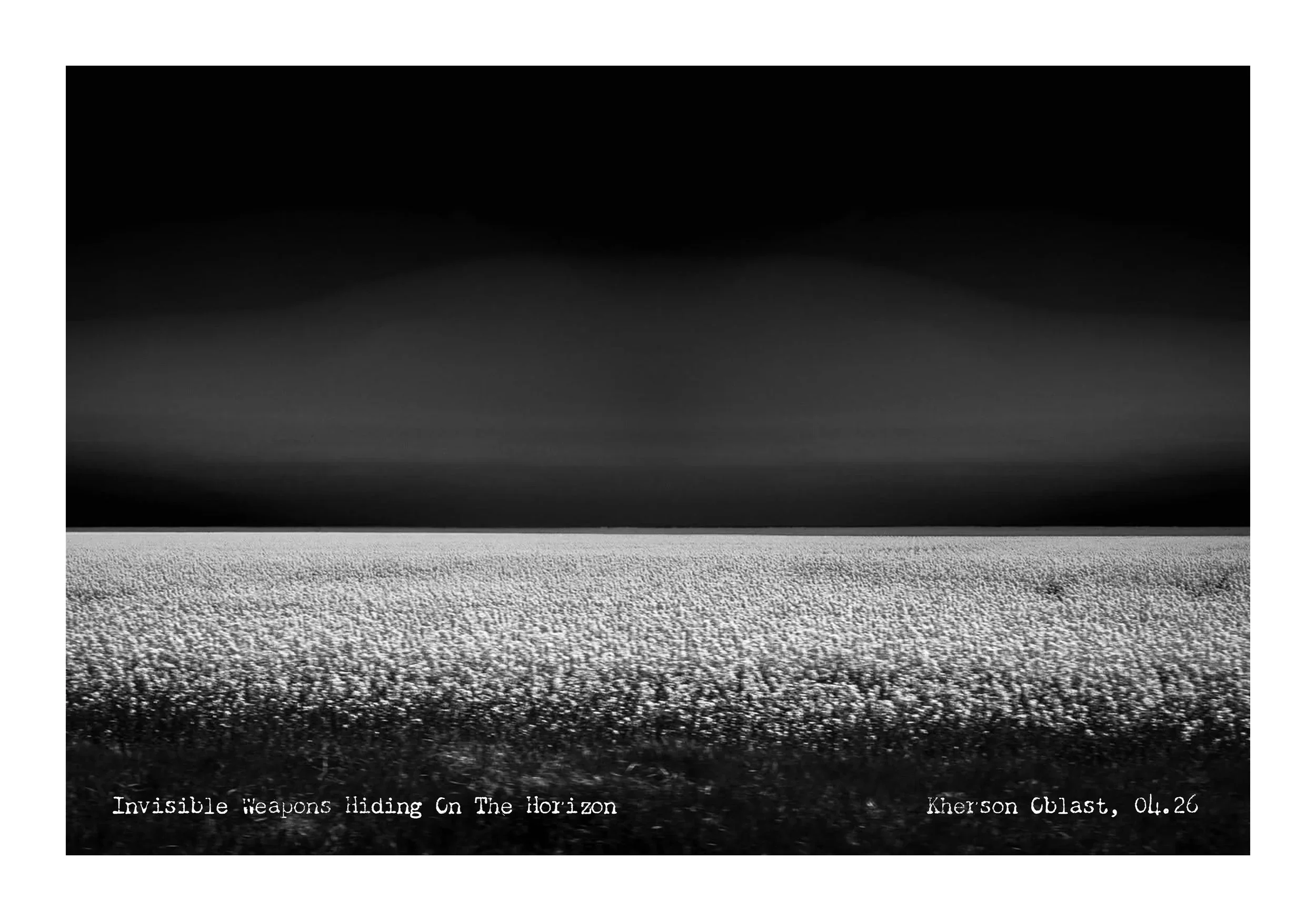
Invisible Weapons Hiding On The Horizon (Kherson Oblast), 2026. Archival silver gelatin print, handpulled silkscreen typescript, 61 × 91.4 cm (24 x 36 in.). Collection of the artist.
Yevheniya & Olishenko, Kherson Oblast
I am Yevheniya. And I am Seventy-four.
You’re seventy-five!
No, I’m seventy-four... seventy-three.
Well, I’m fifty-one, and she’s fifty-two.
Okay then, let’s go with that.
I am Olishenko.
The two of us, we’ve worked together our whole lives.
But we didn’t become close friends until we got here. We’re from the same village and would see each other here and there. She lived on one side, and I lived on the other. I’d see her when she would just be doing her rounds with the cows and calves—just fellow villagers, you know, more like acquaintances back then. But now we’ve become real friends because hard times forced us together.
Trouble came, and we fled those drones together.
Yeah, when the volunteers showed up and started taking people away...
And there were drones all around…
Two groups of volunteers. One group was loading us up, while the others were shooting down drones. We was split into two groups, and hers ran off, hiding in the weeds. And that’s where a drone fell on her, and her leg got hurt. They took her legs out. And her head isn’t okay either.
Was it Friday? I don’t even remember.
We haven’t been home since.
We haven’t seen any doctors or anything, either.
There’s no one left in our village now, and no, we haven’t been to the hospital in a long time.
I really needed to go to the hospital, definitely.
For sure.
I gave everything for nothing. I locked the house, did what I had to. That’s all. And that’s it. And now, I just want to go home. But when I started asking, well... they say there's nothing. No light, no water, nothing.
I say, God, maybe there's power by now.
But there's nothing.
There’s nothing good at all. Just drones, all the time.
Drones…
The first thing that happened, well, it was New Year’s Day at six in the morning. I’d just gotten up and was walking around the house. I was sitting right next to the window when these glass shards — they shattered all over half the house. And on Sunday, I hired some people who glued some kind of plastic sheets to cover the windows. But then some Russians, they came on motorcycles… they started beating me. They wanted me to leave and to take me with them, but I tried to hide behind the TV, while they just smashed up the whole house, tore everything apart.
Were they drinking?
Who knows. But they caught people’s houses on fire that day, and they burned for three days. Half the village’s houses burned down, and all the people fled — there was no one around to put out the fire. That’s what’s happening. That’s just how it is.
Yeah, all we took was just the clothes we grabbed.
I did get medicine to keep hope.
My place is still blocked up. But I can't get back there.
We want to go back and grab some stuff, but we can't get through because of the drones swarming all over the place.
Plus, those motorcycles zipping all around.
They’re rushing all around on motorcycles.
Yeah, and those guys... they stay close to death too.
It's such a scary thing.
But you can see it; they show it in their eyes.
(New friends, bickering and already finishing each other's sentences. Two friends bound by shared trauma as they wait outside a mobile clinic on the outskirts of Kherson, out of immediate danger yet still in the red zone, together trapped in the void between displacement, return, and an uncertain future.)
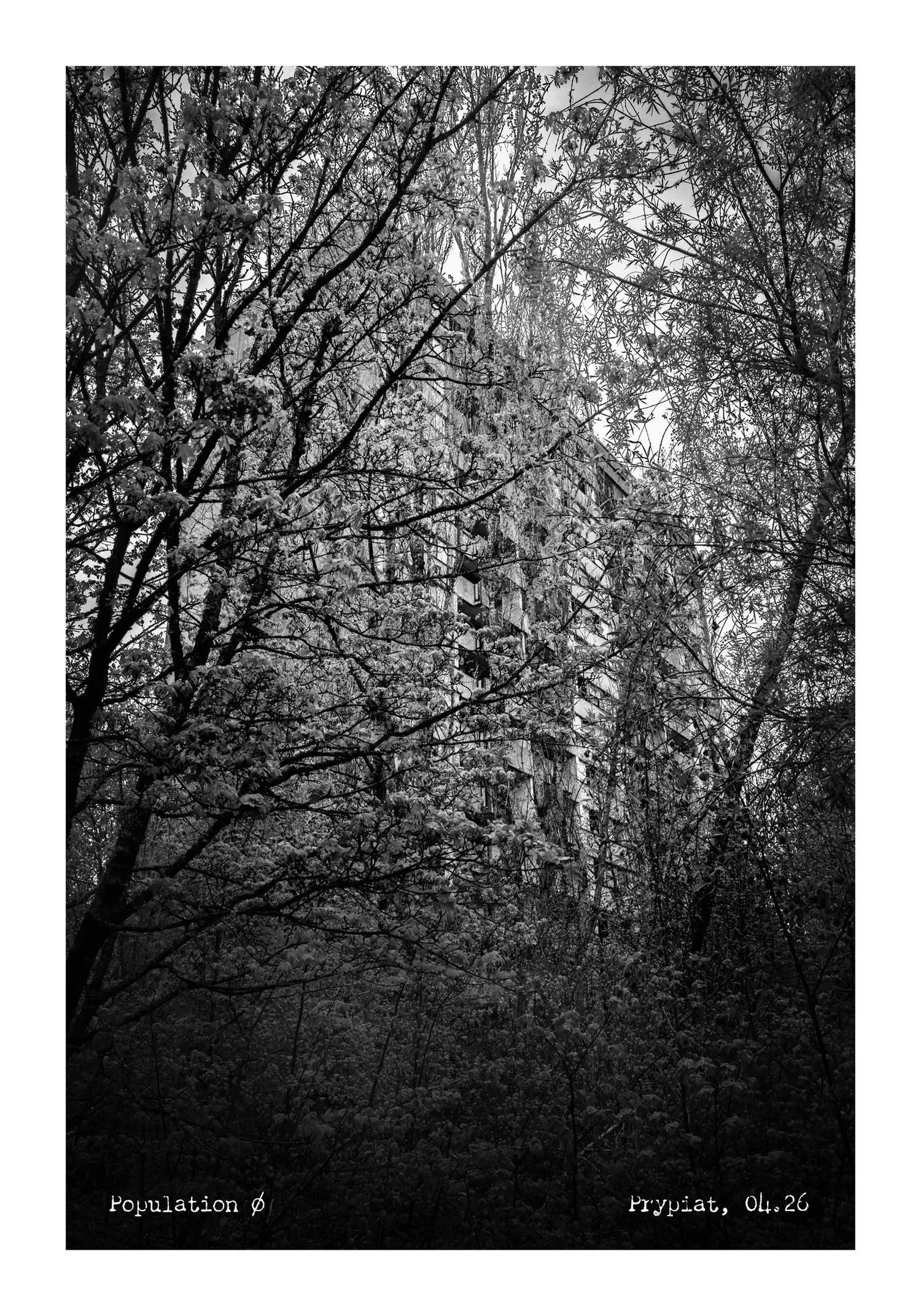
Population 0 (Prypiat, Chornobyl, Ukraine, Exclusion Zone, 40-year anniversary), 2026. Archival silver gelatin print, handpulled silkscreen typescript, 61 × 91.4 cm (24 x 36 in.). Collection of the artist.
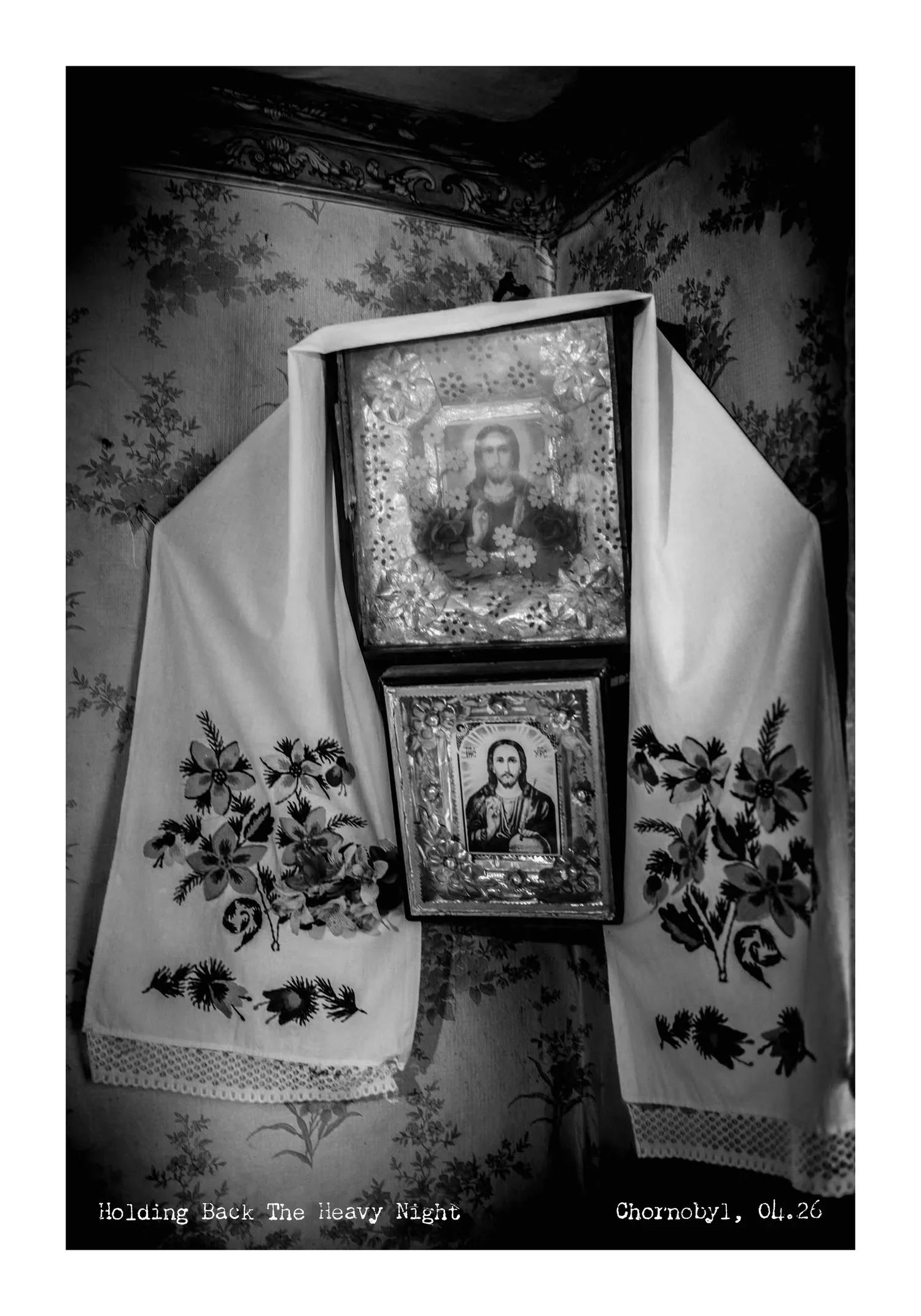
Holding Back The Heavy Night (Chornobyl, Ukraine, Exclusion Zone, 40-year anniversary of disaster), 2026. Archival silver gelatin print, handpulled silkscreen typescript, 61 x 91.4 c m (24 x 36in.). Collection of the artist.
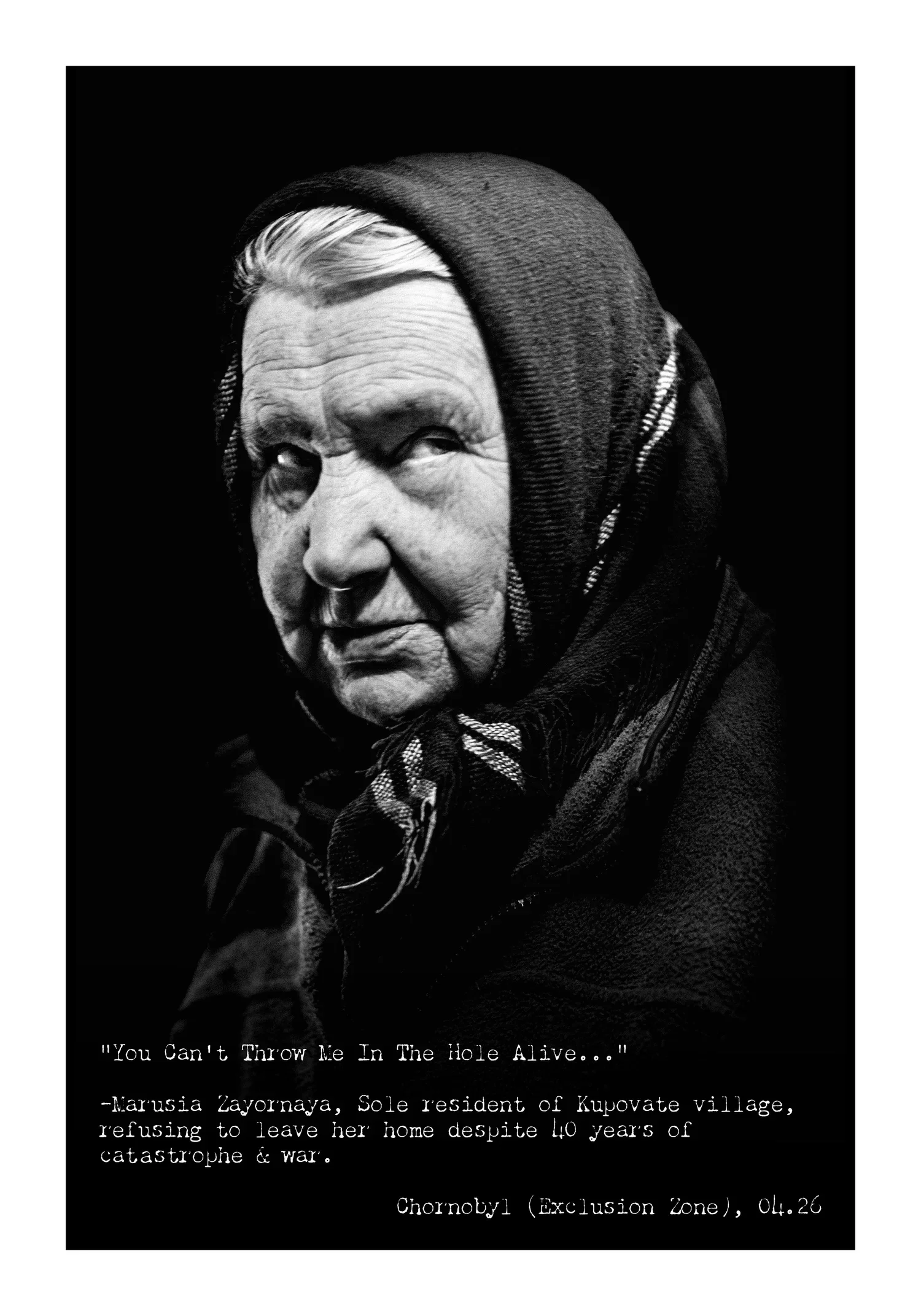
Marusia Zayornaya (Kupovate village, Chornobyl, Ukraine, Exclusion Zone, 40-year anniversary of disaster), 2026. Archival silver gelatin print, handpulled silkscreen typescript, 61 × 91.4 cm (24 x 36 in.). Collection of the artist.
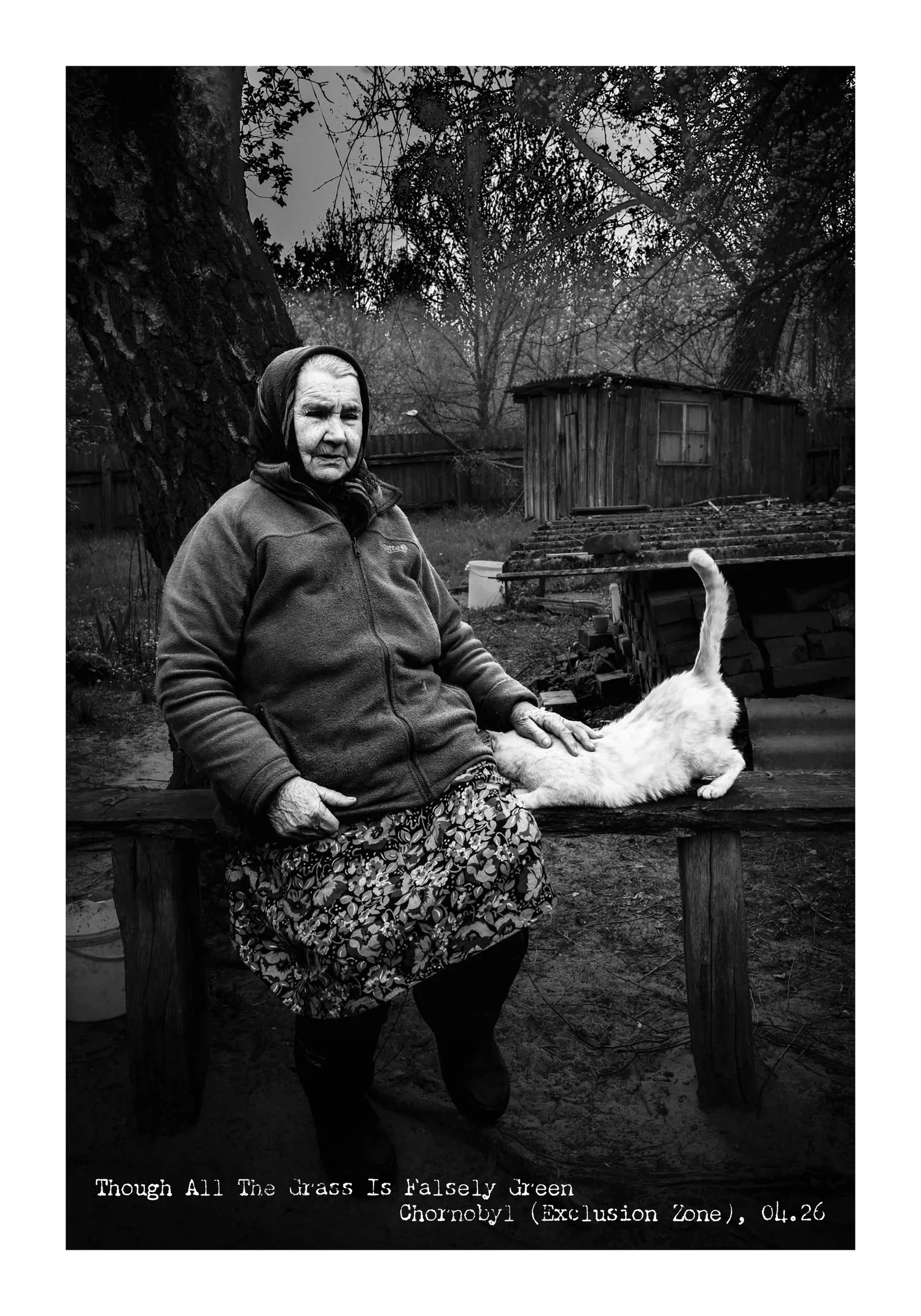
Though All The Grass Is Falsely Green (Chornobyl, Ukraine, Exclusion Zone, 40-year anniversary of disaster), No. 01, 2026. Archival silver gelatin print, handpulled silkscreen typescript, 61 × 91.4 cm (24 x 36 in.). Collection of the artist.
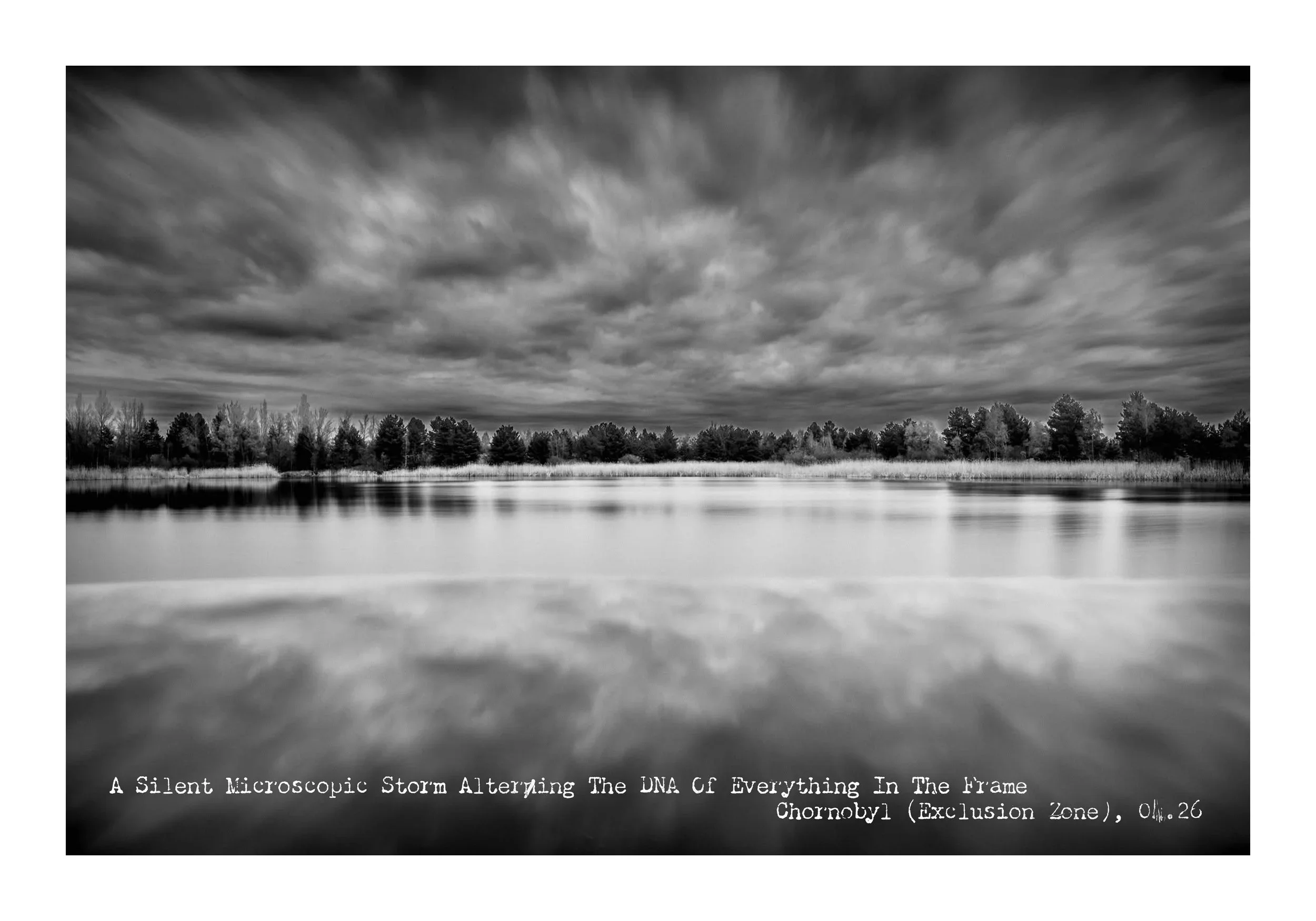
A Silent Microscopic Storm Alterning The DNA Of Everything In The Frame (Chornobyl, Ukraine, Exclusion Zone, 40-year anniversary of disaster), 2026. Archival silver gelatin print, handpulled silkscreen typescript, 61 × 91.4 cm (24 x 36 in.). Collection of the artist.